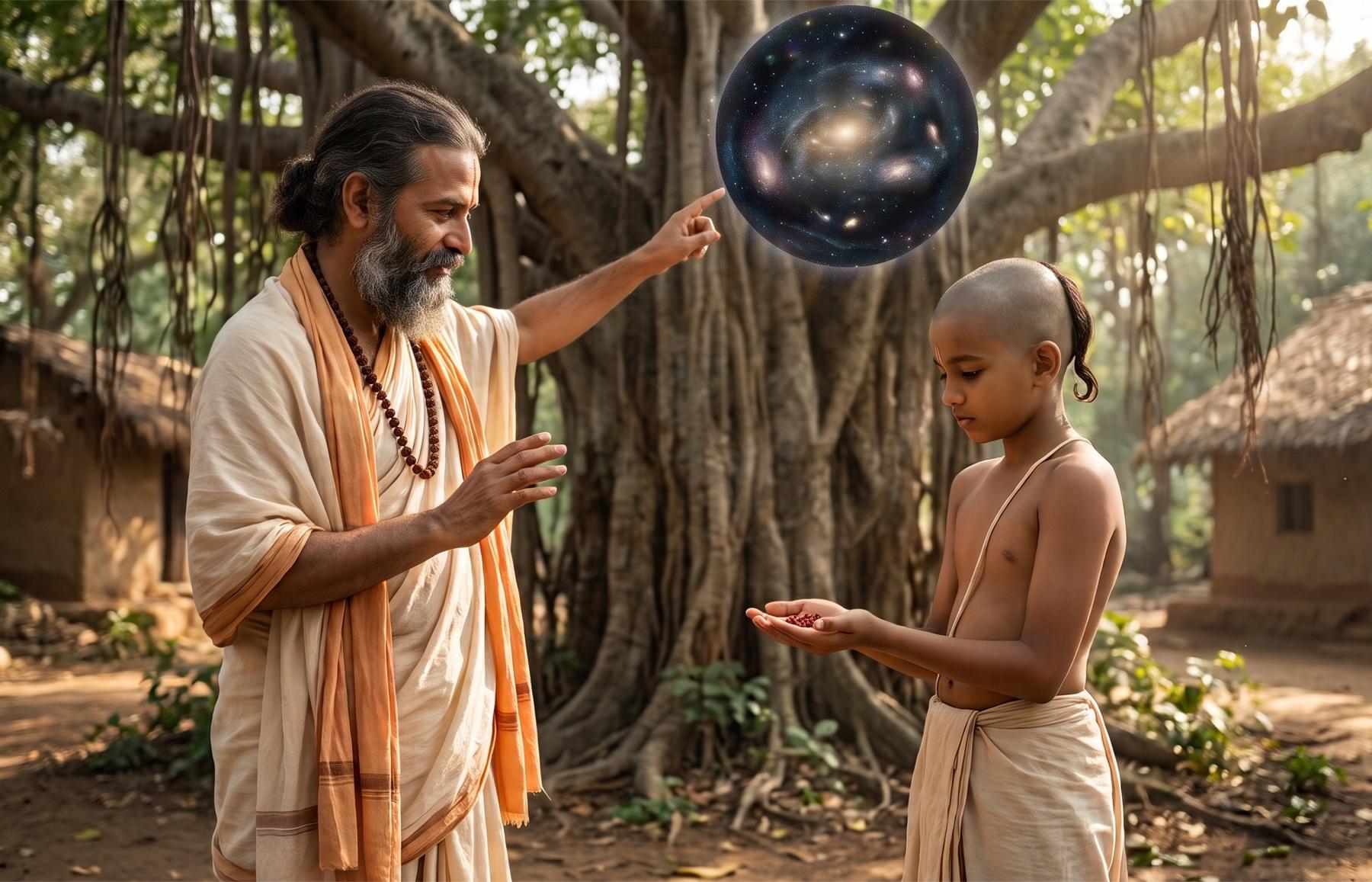
The story of Svetaketu and his father, the sage Uddalaka Aruni, is found in the Chandogya Upanishad. It is one of the most celebrated dialogues in Vedanta, exploring the fundamental nature of reality and the self.
At the age of twelve, Svetaketu was sent by his father to study the Vedas under a teacher. Twelve years later, he returned home, having mastered the scriptures. However, his vast learning had made him arrogant, conceited, and stiff with pride.
Noticing his son's ego, Uddalaka Aruni decided to test his true understanding. He asked Svetaketu, "Did you ask your teacher for that instruction by which the unhearable becomes heard, the unperceivable becomes perceived, and the unknowable becomes known?"
Svetaketu was baffled. He realized his teachers had not taught him this ultimate knowledge, and his pride vanished. He humbly requested his father to teach him this supreme truth. Through a series of practical, everyday analogies, Uddalaka dismantled Svetaketu's reliance on superficial knowledge and guided him to realize the ultimate nature of existence.
Core Philosophical Concepts
Uddalaka's teachings to Svetaketu form the foundation of Advaita (non-dualistic) philosophy. The dialogue uses brilliant analogies to explain how the diverse universe stems from a single, underlying reality.
- The Material Cause (The Clay Analogy): Uddalaka explains that just as by knowing a single lump of clay, everything made of clay becomes known, by knowing the foundational root of the universe, everything in the universe is known. He asserts that all physical forms (like a clay pot or a clay toy) are just "names and forms" (nama-rupa)—the only true reality is the clay itself.
- The Invisible Essence (The Banyan Tree Seed): To explain how the vast universe can emerge from an invisible source, Uddalaka asks Svetaketu to split open the tiny fruit of a banyan tree, and then split the seed inside. When Svetaketu says he sees "nothing" inside the seed, his father replies: "From that subtle essence which you cannot see, this massive banyan tree exists."
- The All-Pervading Reality (The Salt Water Analogy): Uddalaka tells Svetaketu to dissolve a lump of salt in a bowl of water overnight. The next morning, the salt is invisible and cannot be touched. However, if Svetaketu tastes the water from the top, middle, or bottom, it is all salty. This illustrates that Brahman (the ultimate reality) is invisible to the senses but permeates every single particle of the universe.
- Loss of Individual Identity (The Rivers and the Ocean): Uddalaka uses the metaphor of rivers flowing in from the east and west. Once they merge into the ocean, they lose their individual names and forms; they can no longer say "I am this river" or "I am that river." Similarly, all individual beings merge into the ultimate reality without retaining their separate, ego-driven identities.
- Tat Tvam Asi (That Thou Art): This is the climax of the story and one of the four Mahavakyas (Great Sayings) of the Upanishads. After each analogy, Uddalaka repeats this refrain to his son: "That subtle essence—in it all that exists has its self. That is the True. That is the Self. And Svetaketu, That Thou Art." This concept shatters the illusion of a separate self, declaring that the individual soul (Atman) and the universal reality (Brahman) are fundamentally one and the same.