Introducing the concept
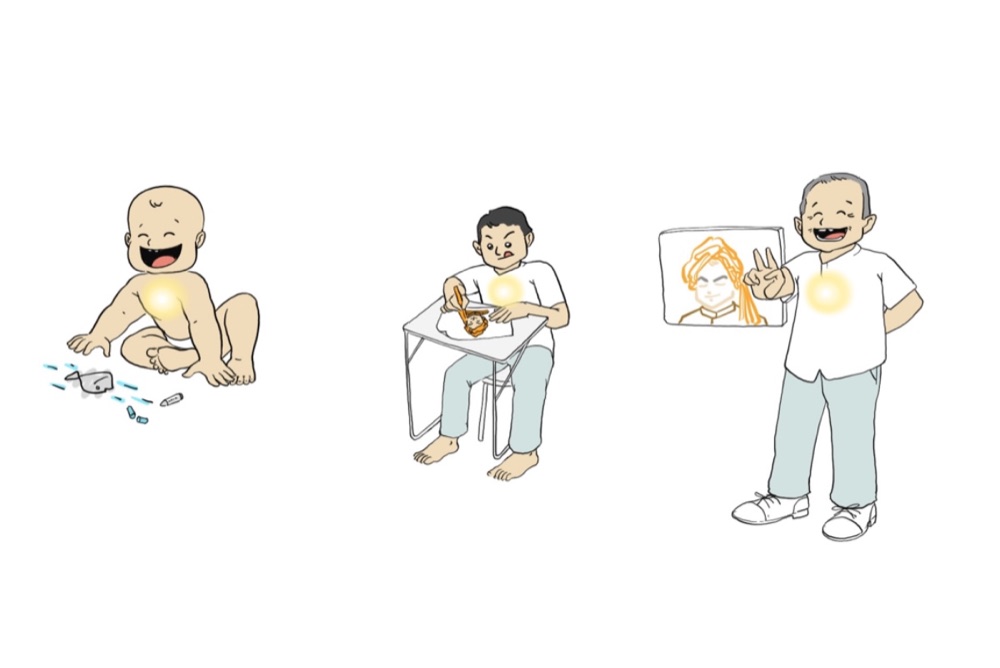
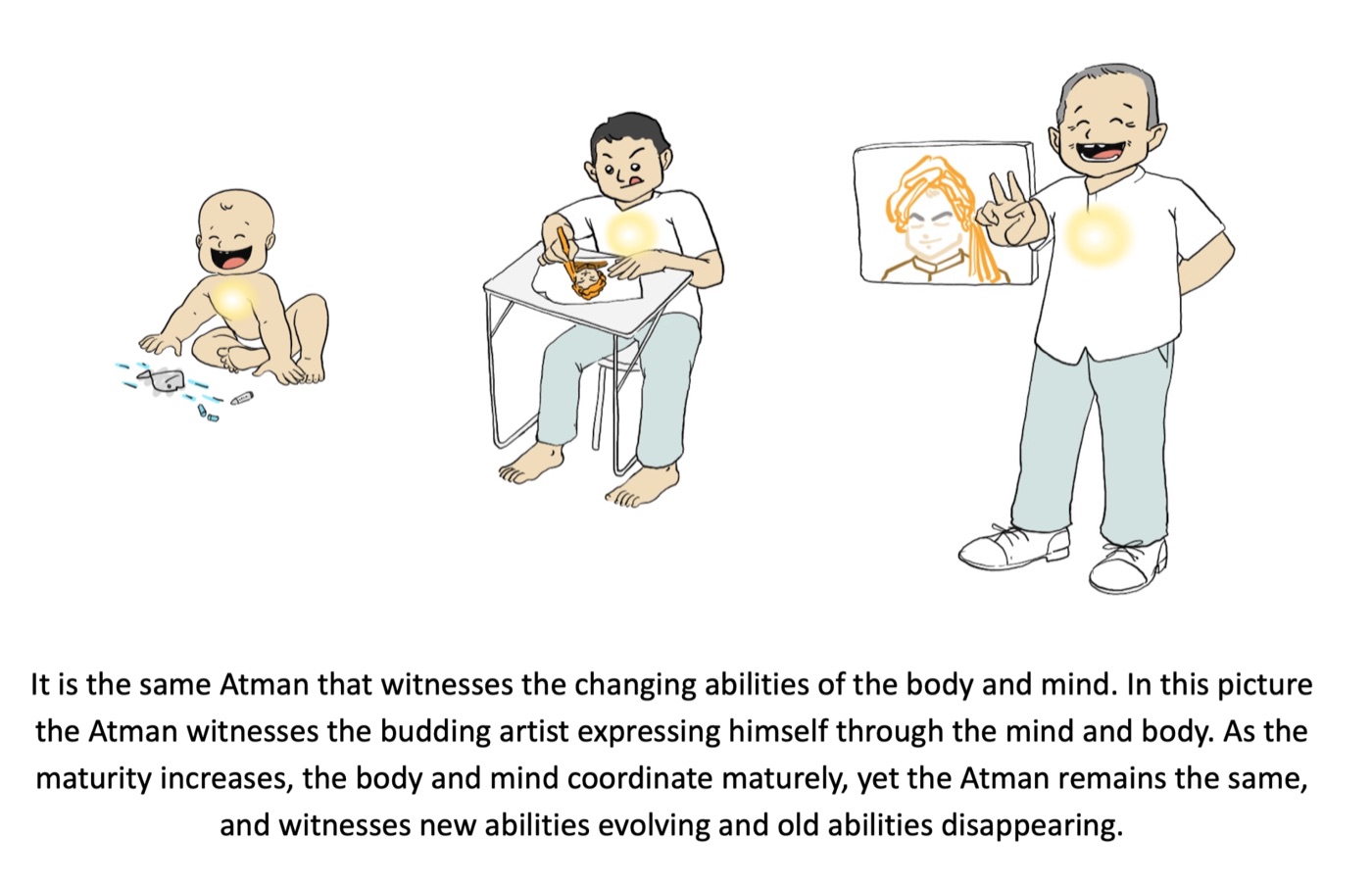
Have you seen one of those videos where a person’s life is shown in fast-forward? From a baby to a mischievous toddler to a scraggly teen to a full-bodied adult. And then the hair begins to turn white; wrinkles begin to appear around the eyes at first, and then across the face and neck; some of the muscles fall away, and the body seems to shrink inwards; the unstoppable forward march of time.
Now ask yourself - was there one person who went through all these changes? Or were different people coming into existence and popping back out of existence at each point of time? Is the baby the ‘same person’ as the adult, or are they two different people? Think back to your own life until now, from the age you can remember. If you are an adult now, the way you look and the way you think today will be very different to what it was when you were a child. But is there a ‘you’ that remains constant through all these changes? Or is a different ‘you’ coming into existence every moment?
Most of you will say that there is indeed a constant ‘I’ that is going through all of these changes. You might have a very different person 10 years back, but it was still ‘you’ and not some other person. You don’t drop out of existence every moment for a new ‘you’ to come into existence the next moment - if this were the case, what is the thread that is stitching all the separate ‘you' together into a unity of experience? And if I was popping in and out of existence, where do my momentary selves go to, and from where will my new momentary selves come from?
There is indeed a single self that goes through all of these changes over a lifetime. We take this for granted without examining the nature of this self. Where is this self? What is this ‘I’ that was there in the baby and now is present undimmed in the adult? If you throw away all the external aspects of your changing body and personality, what is it that remains unchanging?
What is the nature of the self?
If you have been reading the other pages in this lexicon, you would have realized that this is the central question in Vedanta. Again and again, we come back to the question of ‘Who am I?’ Or, what is this that you call ‘I’? You undoubtedly exist, you are aware and are looking out at the world right now, there certainly is a self that is aware, but where is this self and what is its nature? In Vedanta, probing into the self is the pathway to ultimate realization, and we can all do it, right here and now. Let us examine the self using the Pancha-kosha-viveka (Discrimination of the five sheaths).
Going a little deeper
The Pancha-kosha-viveka methodology for self-inquiry is provided in the Taittiriya Upanishad. It guides us in systematically examining ourselves and setting aside everything that is ‘not self’. By peeling away the multiple layers or sheaths (koshas) of ‘not self’ that appear to envelope the Self, we will arrive at the Self.
Layer 1 - Annamaya Kosha (Food Sheath)
On being asked, ‘What is the self?,’ the first answer that is usually given is that this body is the self. Is that not what we instinctively believe? We take it for granted that we are our bodies, that your head, your hands, your feet, all of this put together is ‘you’.
But let us examine this via the Pancha-kosha-viveka lens. Does your body undergo constant changes? Yes it does. We grow thin and fat, my hair grows and is then chopped off, everything that I call my body is constantly in flux.
The body is called the Annamaya Kosha, or the ‘food sheath’. Very simply, if your body is constantly changing, it cannot be you, it cannot be the self which is unchanging. Modern science shows that our cells are constantly being regenerated - cells die and new ones take their place. Almost 90% of your body cells will be totally replaced in a week's time - you have a new body almost every week! Yet all the changes in the body are happening to ‘you’, it is ‘you’ who were a child then, and it is the same ‘you’ who are an adult now,
The self ‘you’ stays constant through all these bodily changes, thus the self is very clearly not the body. Furthermore, you are aware of the body - you can see your arms and legs, you can feel the rumbling in your tummy and the pain in your back. If you are aware of the body, if it is an object to you, then it cannot be you, it cannot be the self. You are the experiencer of the body, you are not the body.
Let us set aside the body and move further inward.
Layer 2 - Pranamaya Kosha (Vital Sheath)
The next candidate that comes forward in answer to the question ‘Who am I?’ is the Pranamaya Kosha or the sheath of the prana (vital force or life force). In other words, are we not the life force that animates all of our bodies? Isn’t it this life force that separates us from inanimate objects?
The life force or vital force is manifested as the breath. The word prana is used both for ‘life’ and ‘breath’; when life leaves the body, the breath stops. Now ask yourself the same two questions we asked of the Annamaya kosha - does the breath go through change, and are you aware of the breath?
Indeed, the breath goes through constant change. It is regular and long-drawn when you are calm, shorter and irregular when you are anxious. Each in and out breath has a beginning and an end; the prana is in continuous movement. If the prana is changing, it cannot be you, since you remain constant through all the movements in the prana. Also, you are the witness of the prana. Close your eyes and observe your breath for a minute. Watching the breath is a good way to calm yourself down. But if you are the witness of prana, you cannot be the prana.
So while the prana might be a better or more subtle response to ‘Who am I?’ than the body, it is still not you. Let us set it aside and move deeper.
Layer 3 - Manomaya Kosha (Mind Sheath)
Now comes an even stronger candidate - the manas or mind. We very often identify ourselves with our minds, don't we? Our thoughts, feelings, emotions - these are what we consider to be the self. Go through our page on Antahkaraha (Inner Instrument) to get a deeper understanding of what the mind is in Indian philosophy.
Our mind gives us our personality; our mind provides us our will power[1]. Thus it seems logical to say that we are our minds - it certainly seems to make a stronger case for itself than the body or the prana. But let us examine the mind with the same two questions and see if it stands the test.
Does the mind change? Of course it does, it is in constant flux. It is chattery at most times, quieter in meditation, and races around when you are anxious.
Are you aware of the mind? Yes you are - are you not the witness to your thoughts, feelings, emotions, sensations right now? When you say ‘I am uncomfortable in this chair,’ there is an ‘I’ to whom the feeling of discomfort is appearing. This is a subtle but crucial point to understand, do dwell on it - you are the witness of the mind. Our pages on Chit (Consciousness) and Antahkarana[2] (Inner Instrument) provide further explanations and illustrations to understand this distinction between the mind and the self.
The mind constantly changes, and the mind appears to me. The mind, thus, cannot be the self. Let us set the mind aside too. We will have to go deeper.
Go through our page on Antahkaraha (Inner Instrument) to get a deeper understanding of what the mind is in Indian philosophy.
Layer 4 - Vijnanamaya Kosha (Intellect Sheath)
Further inwards than the mind sheath lies the Vijnanamaya Kosha, or the Intellect Sheath. This is where the Buddhi (intellect) sits.
The mind is like a screen where various thoughts and images come and go, sometimes seemingly at random. The mind, thus, can appear to not be in our control; it will throw up multiple questions, multiple interpretations, multiple possible courses of action. It is the buddhi, on the other hand, that examines the contents of the mind and makes a firm determination or decision. The buddhi or the Vijnanamaya kosha is what gives us our sense of agentship or doership; it is what makes us feel in control. The Vijnanamaya kosha is said to have the power of knowledge.
What do you identify with more closely? The thoughts, sensations, emotions, and images that flash in your mind (the Manomaya kosha), or the sense of knowledge, will, and control that you seem to possess (Vijnanamaya kosha)? Our guess is that you will associate yourself more closely with the Vijnamaya kosha - it certainly seems to be a much stronger candidate for ‘selfhood’ than the manas.
You know where this is going. Let us ask the same questions of the intellect sheath. Does your knowledge of things in the world come and go? Do you gain knowledge of any subject and then subsequently lose it? Of course yes. Anyone who has struggled through a mathematics concept until they reach the ‘Aha!’ a moment of understanding knows that knowledge is something that can be gained. And anyone who scratches their head trying to recall the name of someone they met a few months back knows that knowledge can be lost. Similarly, our sense of will or agentship also goes up and down - sometimes we feel fully in control, at other times we don’t.
Next question - are you aware of the buddhi? Now we are reaching quite subtle levels of inquiry. Ask yourself - when you ‘know’ something, are you not witnessing the knowledge? Of course you are, otherwise how can you know? Knowledge appears to you; your agentship - your sense of ‘I know’, ‘I decide’, ‘I am doing this’ - is also appearing to you.
The Vijnamaya kosha is in constant flux, and it appears to you. So the Vijanamaya kosha, too, cannot be the self!
At this point you might be throwing up your hands and wondering if there is an end to this chain. There is, but we have another step to take, an even more subtle leap. Let’s go.
Layer 5 - Anandamaya Kosha (Bliss Sheath)
Imagine the state where your mind is cleansed of all activity - no thoughts, no sensations, no sense of knowledge or will, no fluctuations whatsoever. A complete blankness. This is how your mind would be in deep sleep. In Vedanta, this ‘unmanifest’ state of the mind, this apparent blankness, is called the ‘causal’ state. It appears to be a void but it in fact is the highly concentrated state where all possible experiences, all possible concepts, all possible states of existence are present in their seed state. It is the unmanifest potential state behind all the other layers of the self. It might seem to be empty, but it is anything but! This is called the Anandamaya kosha or the ‘bliss sheath’. It is likened to bliss and peace because it is closest to the self at its most pristine, untouched and unaffected by the objects of the world.
Sri Sankaracharya uses a simple analogy to explain the Anandamaya kosha - when night falls, all the differences in the world - all the distinct objects - seem to disappear into a uniform blackness. But all the objects are still present right where they were; they will reveal themselves again when you shine light on them. The objects in their seed or unmanifest state are present right there in the nighttime darkness, and they manifest themselves when the sun rises. Similarly, in the seeming darkness of the mind lie the entire universe of possible thoughts, sensations, and knowledge in their seed state. The Anandamaya kosha can be thought of as the subconscious - the source from which all thoughts emerge, and into which all thoughts merge back.
Okay, you might be asking, finally, have we arrived at the self? We seem to have reached the absolute end of the road. What can be present beyond the unmanifest source? The Anandamaya kosha is the self, right? Not quite.
We move in and out of the causal or the deep sleep state, do we not? While awake, we look back and say ‘I was in deep sleep.’ We suggest that you read the page on Sushupti (Deep Sleep), because what we are going to say now is a very subtle but crucial idea. Even the blankness of deep sleep is something that appears to you; it is something that is experienced. As Swami Sarvapriyananda says, deep sleep or the causal state is not the absence of experience but rather the experience of absence - the absence, the void, the blankness is a concept that appears to you, and thus it is not you! You are not the bliss sheath either.
You are That which is beyond the five sheaths. But what can that be?
Tying the threads together
We considered all the possible aspects of our personality, beginning from the physical body and then moving into more and more subtle layers. But nowhere have we found the self. Every sheath seems at first like a good candidate to pin the label ‘self’ on to, but on closer examination we had to unpin the label.
So does that mean that there is nothing that we can call the self - is the self a void or an emptiness or simply a non-existent fiction?
Absolutely not. If there is one thing and one thing only that you can be certain of, it is that you exist. Everything that is appearing to you might be unreal, in other words everything that appears might be impermanent, constantly changing, without substance of its own, but what cannot be doubted is that there is a Self to whom the unreal world is appearing. The world I consider ‘real’ right now might be a dream, or perhaps a superior intelligence has created a sophisticated simulation or computer program that I am inside - even so, the dream or the simulation is appearing to me; there is a Self that is getting deceived by the simulation or the dream.
So, there is absolutely no doubt that there is a Self, but the Self is to not to be found in the five sheaths. Is there anything beyond the five sheaths?
Indeed there is. Think about how we eliminated each of the five layers - we realized that each of the layers could not be the self because they were each appearing to us. The five sheaths represent everything that can possibly be called an experience or appearance, including the blankness of the bliss sheath. But to what do all of these sheaths appear?
They appear to Consciousness, the pure Subject to which all the sheaths are objects. If you haven’t already, then do go through our page on Chit (Consciousness). You are Consciousness, the Eternal Witness. The Self, the Atman, the answer to the question ‘Who am I?’, is Pure Consciousness, the untouched, unchanging, indestructible Observer behind the five sheaths.
Swami Nikhilananda writes, ‘As the Self is too subtle for ordinary understanding, … [we] gradually train the mind to dwell on finer and finer aspects of the Self [the five sheaths]... The innermost Self [the Atman] is something different from the body, the sense organs, vital forces, mind, intellect, and Cosmic ignorance. It is the eternal Witness, Existence, Knowledge, and Bliss Absolute.’
‘This is the secret of spiritual life,’ Swami Vivekananda said, ‘to think that I am the Atman and not the body, and that the whole of this universe with all its relations, with all its good and all its evil, is but a series of paintings… of which I am the witness.’
Reflect on this
If our real nature is Pure Consciousness, then can we all be different individuals? Does it make sense to talk about differences in Consciousness? What are the implications of this?