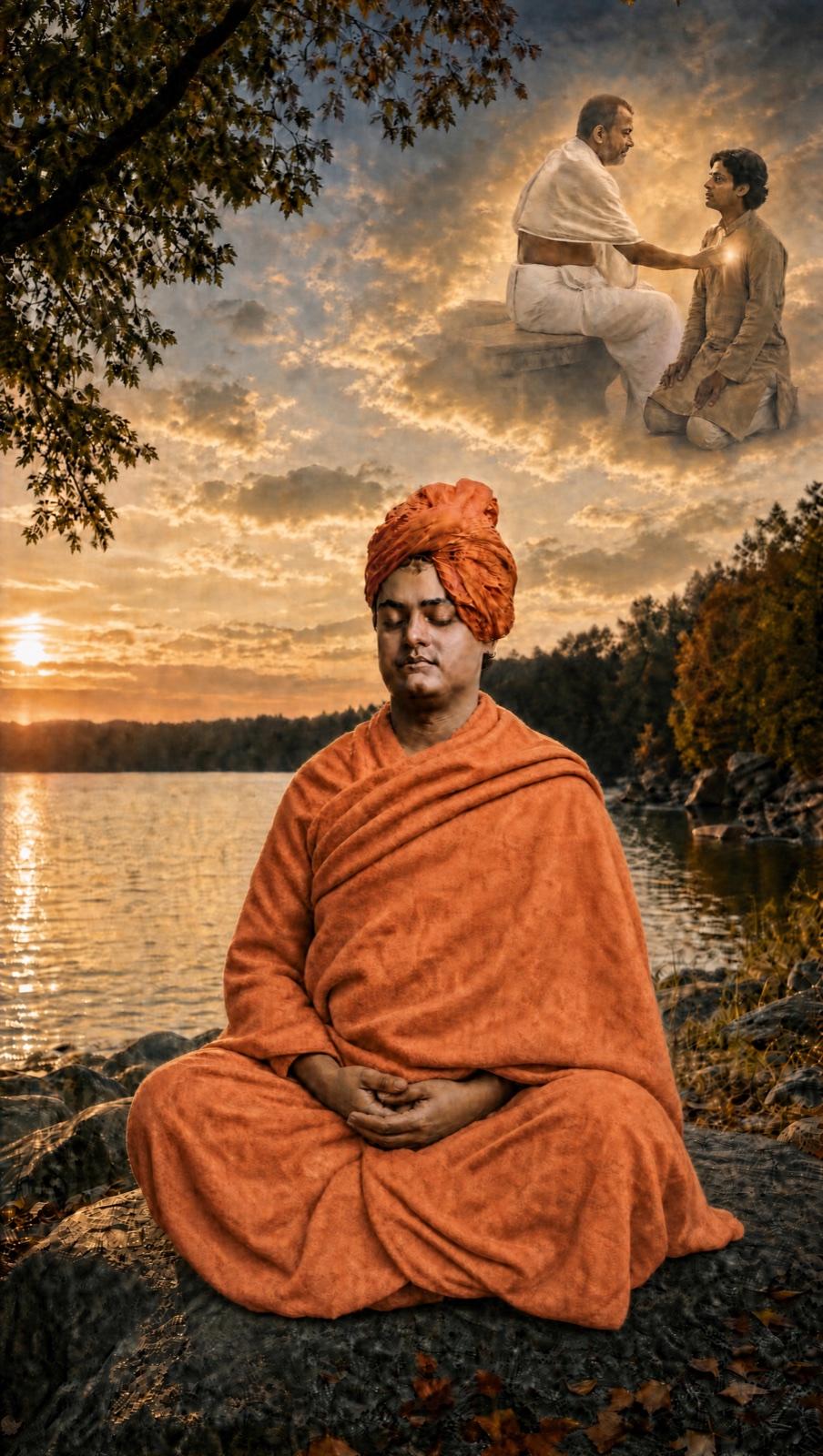
Swami Vivekananda’s divine experience at a lake in America is described as a sudden, overwhelming realization of Oneness, in which the whole world seemed to dissolve and merge into the Akasha, and then even the Akasha and the ego-consciousness vanished. Coming back from that state, he began again to perceive houses, doors, windows, verandahs, and other things. He says, “One day in the temple-garden at Dakshineswar Shri Ramakrishna touched me over the heart, and first of all I began to see that the houses-rooms, doors, windows, verandahs-the trees, the sun, the moon-all were flying off, shattering to pieces as it were-reduced to atoms and molecules-and ultimately become merged in the Akasha. Gradually, again, the Akasha also vanished, and after that, my consciousness of the ego with it; what happened next I do not recollect. I was at first frightened. Coming back from that state, again I began to see the houses, doors, windows, verandahs, and other things. On another occasion, I had exactly the same realisation by the side of a lake in America.... Know-this knowledge of Oneness is what the Shastras speak of as realisation of the Brahman, by knowing which, one gets rid of Fear, and the shackles of birth and death break for ever.”[1]
This lake-experience is placed in the same stream of his earlier samadhi experiences, where deep inward absorption could still be connected with guidance for others. In the narrative, it is asked whether this was not the kind of experience he had at Camp Percy, where he had also entered into samadhi on the shore of Lake Michigan and at Camp Percy in New Hampshire, and where Sri Ramakrishna had “appearing to him, drew him back ‘to the Work for which he had come to the world.’”[1] The account also explains that Sri Ramakrishna had kept the “key,” so that Swami Vivekananda would not remain long in the highest state, because he had work to do.[2]
At Camp Percy, beside a lake in the White Mountains of New Hampshire, Swami Vivekananda had gone into profound solitude, reading the Gita and meditating for hours. He wrote, “This is one of the most beautiful spots I have ever seen.... Imagine a lake, surrounded with hills covered with a huge forest, with nobody but ourselves, So lovely, so quiet, so restful! And you may imagine how glad I am to be here after the bustle of cities. It gives me a new lease of life to be here.... I will meditate by the hours and days here and be all alone to myself. The very idea is ennobling.”[3] A story is then told of how a workman found him lying on the shore “to all appearances dead,” and how, after efforts to rouse him, signs of life appeared and he gradually returned to normal consciousness; it is said that he had presumably entered into Samadhi.[3]
In the same Camp Percy episode, Josephine MacLeod describes how she and others feared he had “left us,” and how he later spoke as if soliloquising: “Who am I, where am I?” Thrice he spoke like that, and then, wide awake, he saw them, was “very much embarrassed,” and said, “I am sorry to have frightened you all. But I have this state of consciousness now and then. I shall not leave my body in your country. Betty, I am hungry, let's hurry.”[4] This shows that the samadhi-state could come and go, and that he returned to ordinary consciousness to continue his mission.[4]
So, the divine experience at a lake in America is presented as “exactly the same realisation” as his Dakshineswar experience: the dissolution of the perceived world into the Akasha, the vanishing of even the Akasha and the ego-consciousness, and then a return to normal perception, with the realization identified as “realisation of the Brahman” that breaks fear and the shackles of birth and death.[1]