Introducing the concept
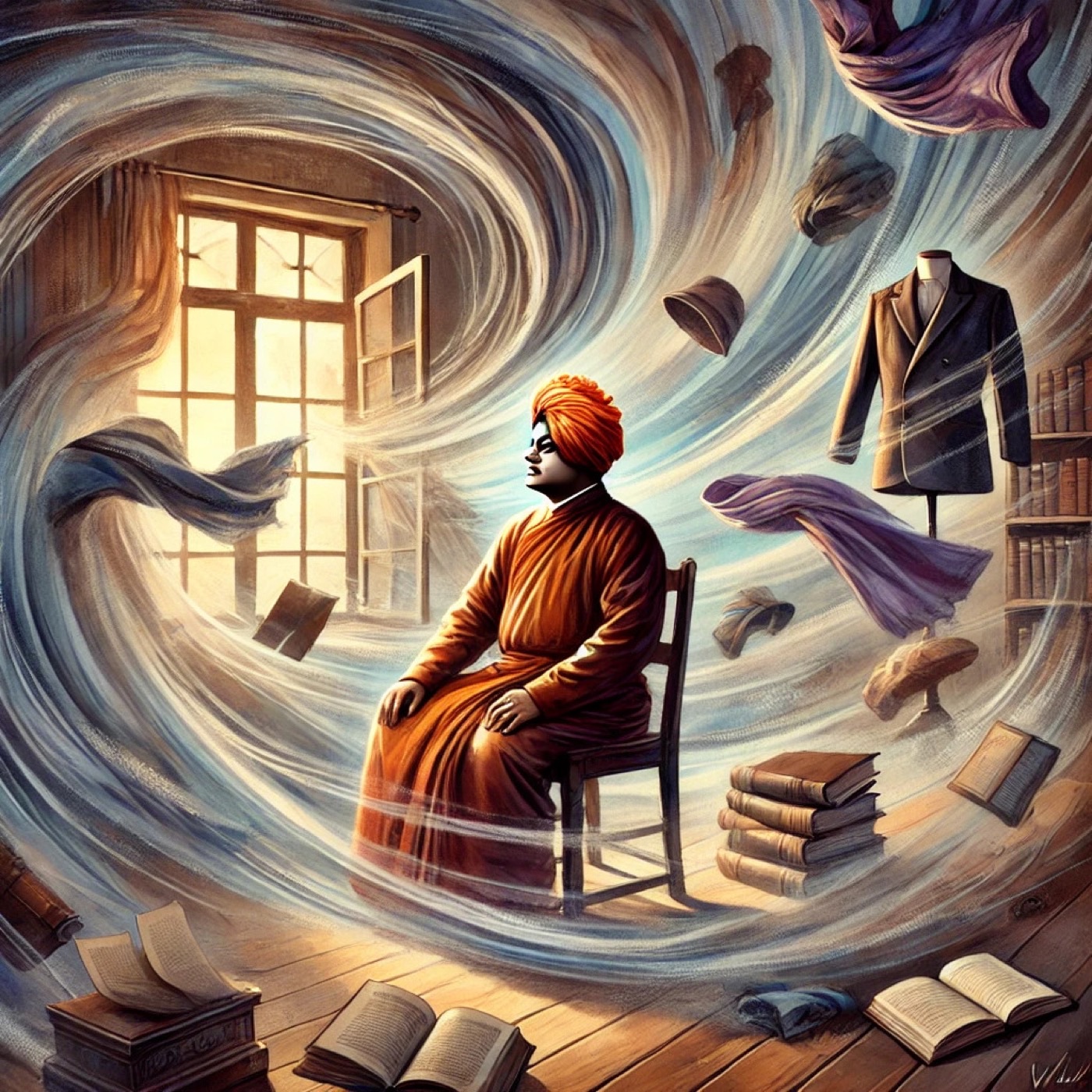
Have you ever been flooded with the realization that the world is deeply mysterious? Have you tried examining the world closely, only to find paradoxes at every turn and infinite regresses wherever you look? Have there been times when the sheer absurdity of the world struck you hard? Has the world at times seemed to you like a mirage in the desert? Have you wondered if the world we take to be real is just one big dream? If yes, then you are well on the track to receiving the Vedantic teachings. If not, then you must examine the world a little more sharply.
Take any object in front of you and ask - ‘Where did it come from?’. To whatever answer you get in response, ask again ‘Where did that come from?’ Keep going like this, taking explanatory leaps, and you will reach the fundamental particles and forces of the physical world. ‘Where did that come from?’ Perhaps you might go back to some form of energy which manifests as all matter. ‘Where did that come from?’ How can you answer this question? Can it have a coherent answer? Where does the chain of causation begin? Can it have a beginning?
It seems like there is no possible way to go all the way back, step-by-step, to the source of the object we are looking at; it seems like there is no way in which a sequence of events can be stitched together which will result in this object existing; yet here the object undeniably is!
When you wake up from a powerful dream the next time, look around at the world and ask yourself - ‘Am I sure this is not a dream?’ Perhaps in your dream you were waking up from another dream, which means you are still in the dream? If it seems obvious to you that this is the real world, ask yourself if you can be really sure. When you were in your dream, everything seemed real to you, the dreamer! The ‘dreamer you’ felt happy and sad, felt pain and pleasure, and went about the dream world in all seriousness. Why then cannot this world you are in be a great dream?
Consider one of Zeno’s famous paradoxes. Let us say you need to run across a 100-meter race track - the starting point is A, and the end point is B. To cover the distance between A and B, you would first need to cover half the distance between A and B. With us so far? You cannot cover the full distance without first covering half the distance - pretty basic. Let C be the halfway point between A and B. Now, to cover the distance between A and C, you first need to cover half of the distance between A and C, right? Let that midpoint be D. To then cover the distance between A and D, I first need to cover half the distance between A and D…
Do you see where this is going? There are infinitely many steps that you will have to cover to reach B from A. But since infinite steps will take infinite time, you will never be able to reach B. Yet you seem to be able to. How? That’s the paradox.
If you closely observe and think about everything around you, you will find paradoxes everywhere. You will find everything we take for granted to be on shaky ground. What is space? Where are the dividing lines between one object and another? If you break down a table and turn it into a chair using the same wood, at what exact point does it stop being a table, and at what point does it become a chair? What is time? Does time have a beginning; if so, what happened ‘before’ the beginning?
How can I be sure that the way I am perceiving the world is the same as the way everyone else is perceiving the world? Can I even be sure that what I am perceiving is not a deception played on me by my own senses - or by an external power? Can I be sure of anything at all?
When did the world begin? If it began at a fixed, finite point in time, where did the world come from - and where did that source substance in turn come from? If the universe is infinitely old, then an infinite amount of time must have passed before we reached the current moment; since an infinite amount of time can never be covered, the current moment can simply never be reached - there is no way this world around me at this moment in time can exist, yet it seems to exist!
Impossible, yet somehow occurring - that is the paradox at the heart of existence. At every turn we find the World to be deeply, irreconcilably mysterious, and yet here it is in front of us! The more you examine the world, the more like a haze or a dream it seems - fundamentally unreal; yet here it is appearing undeniably all around you. This is Maya, one of the central concepts in Advaita Vedanta.
In common parlance in India, Maya is taken to mean ‘illusion’. It is often used negatively or dismissively, as in ‘The world is just an illusion’. But, as Swami Vivekananda said powerfully and repeatedly, Maya does not mean illusion in the way we typically understand the word, Maya is very simply a statement of fact; Maya is not a fancy theory or an exercise in speculation, but a faithful reporting of the facts as they appear to us.
In Swami Vivekananda’s words, ‘When the Hindu says the world is Maya, at once people get the idea that the world is an illusion… But the Maya of Vedanta, in its last developed form, is neither Idealism nor Realism, nor is it a theory. It is a simple statement of facts - what we are and what we see around us[1]’.
This world of appearance is Maya. Let us examine this further.
Note to the reader - It might be best to first read through the pages on Brahman, Sat (Existence), or Chit (Consciousness) before diving further into Maya. It is better to steady yourself on the unshakeable ground of Reality before examining the phantom-like nature of Maya.
Going a little deeper
Maya is very simply everything that appears - ourselves (our bodies and minds) and the universe around us. In short, Maya is this entire World, this magnificent magic show that we are part of. More precisely, Maya can be seen as space, time, and causation. Everything in the world must necessarily be described in the framework of space-time-causality. Can you think of any phenomenon that is outside of the bounds of space-time-causality? You will not be able to. Even a thought or a concept has a ‘position’ in mental space, has a beginning and ending - and direction - in time, and is causally linked to other thoughts before and after it. Looking at Maya as space-time-causality is simply another way of saying that Maya is the world as it is, and as it can possibly be. Nothing in the world can be outside the framework of space-time-causality; nothing in the world can evade the grasp of Maya.
What is the nature of Maya? If we examine the world closely, we find it to not be real. But at the same time we do see the world, we cannot dismiss it. Maya has this peculiar quality of being neither real nor unreal. It is not absolute reality (since that is only Brahman or Consciousness), but it cannot be dismissed simply as unreal either, because it indeed appears to us. Thus Maya is described as Anirvachaniyam (something that is neither real or unreal). It is fundamentally inexplicable.
We will now be introducing two other lenses via which to look at and grasp the nature of Maya. The first is the concept of error, or Khyati. We take something erroneously to be what it is not; we have a clear cognition - or a mental image - that is misleading. You see a snake on the road and you jump up in fear, only to realize that it was actually a rope. You erroneously saw a snake - i.e. you had the cognition of a snake - where there is only a rope. If you have read the page on Adhyasa (superimposition), then this concept of erroneous cognition will be clear.
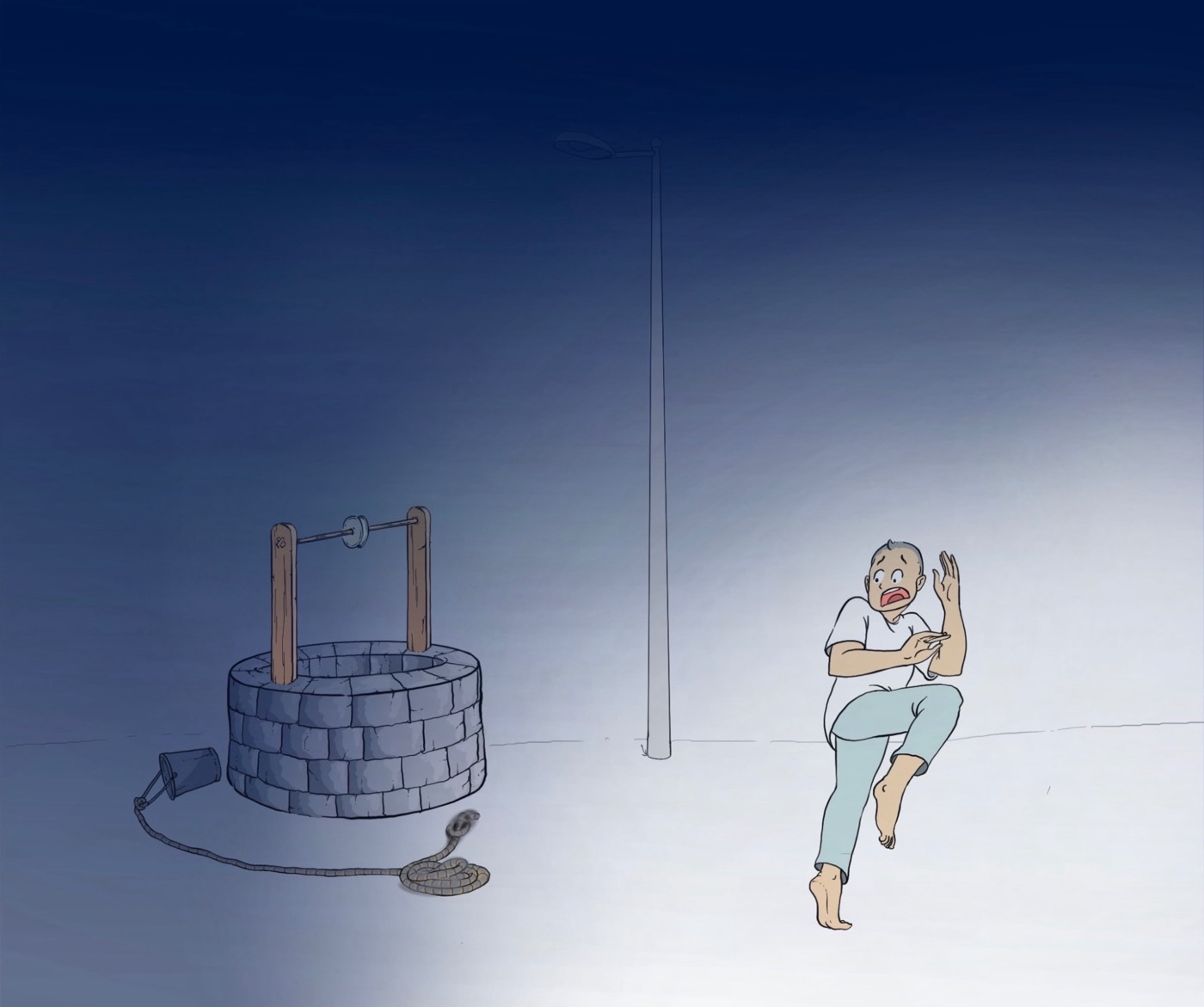
There are various theories of cognitive error in Indian philosophy, each philosophical school differing in the way they describe the nature of this error. Advaita Vedanta subscribes to Anirvachaniyakhyati, which is the theory that the erroneous cognition is neither real nor unreal. The cognition of the snake is not real, but it cannot be dismissed as entirely unreal either, since you indeed saw a snake and got scared by it! Until the knowledge of reality dawned on you (‘Ah, that is just a rope!’), the erroneous cognition of the snake held its grip on you. Thus the snake can be seen as an intermediary level of reality - when my ignorance is washed away by knowledge of the truth, I will be able to see the higher level of reality (i.e. the rope).
On the same lines, Advaita Vedanta says that the entire World - or Maya - can be categorized as Anirvachaniyakhyati. The World that is Maya appears to us but is not ultimately real; it has the status of intermediate or ‘transactional’ reality (i.e. Vyavaharika Sat); Maya ties us down in its net as long as we remain ignorant of the nature of reality. Any ignorance can only be removed by knowledge. The ignorance of our real nature (i.e. Avidya) can only be removed by Knowledge (i.e. Vidya) of who we really are and what the underlying Reality of the World is. This Knowledge is provided by Vedanta.
When we truly realize the Vedantic teachings, the Avidya drops, and we awaken from the Vyavaharika level (transactional or intermediate reality) to the Pamarthika level (Absolute Reality which is Brahman). Once Knowledge dawns, we will continue to see the World but will not be captive to its charms or horrors - the cognition of the world continues, but we will be free of the net of Maya. Just as, even after you gain the knowledge of the rope, you will continue to have the cognition of the snake, but you will now not be scared anymore - knowledge has freed you from the fear of the snake.
The second lens is to view Maya as the power of Iswara. Let us take some time to understand this. Maya is often used interchangeably with Avidya (Ignorance). As we saw just now, Maya retains its hold as long as Avidya is not overridden by Knowledge of Reality - thus Avidya and Maya go hand-in-hand. But Maya and Avidya can be seen as two sides of a coin, or the same idea seen via two different perspectives. From our perspective as sentient beings in the World, there is Avidya - we are bound by this Ignorance. This is the ‘veiling’ or ‘concealing’ aspect of Maya-Avidya, where Ignorance sits as a veil between us and Reality. Let us call this the ‘bottom-up’ perspective.
From the ‘top-down’ perspective, on the other hand, Maya-Avidya can be seen as the power of Iswara. This is the ‘projecting’ aspect of Maya-Avidya, where this manifest World is projected from the Unmanifest Absolute that is Brahman.
Maya-Avidya as the projecting power, Maya-Avidya as also the limiting veil[2]. In other words, ignorance is at the very root of manifestation - the manifest World stays only as long as we remain in ignorance. When we gain Knowledge of the Absolute, the manifest World drops.
When we brush aside the veil of Avidya, Maya loses her power over us.
How can the same thing be both a power as well as a limiting factor? Sri Ramakrishna explains this beautifully with the following example. When we get bitten by a snake, the poison from the snake’s fangs can kill us. But the same poison does not harm the snake; in fact, the poison in the snake’s mouth represents the power that the snake has over us - the power to hurt and even kill us. A small bit of the poison in us can kill us, the entirety of the poison in the snake’s mouth gives it power. Similarly with Maya-Avidya - a small bit of it in us is our ignorance, the entirety of it with Iswara is His power[3].
Tying the threads together
‘If everything is the Atman or Brahman,’ Swami Ranganathananda said, ‘the universe of name and form cannot be an illusion. The Upanishads consider it as Maya; but this does not mean illusion. Maya is a mere statement of fact, what we are and what we see around us. It refers to the inner contradiction involved in our experience of the world and in our knowledge of it. These contradictions will remain, say the Upanishads, so long as we remain at the sensate level, so long as we fail to take into account the Atman, the Self behind the not-Self, the One behind the many.[4]’
When we try to understand the world at a fundamental level, our knowledge breaks down; it seems like it is impossible for the world to exist, but we do observe it with all our senses, we cannot deny it. This is the unresolvable contradiction Swami Ranganathananda is mentioning between what we experience and what we understand.
Ultimately, Maya makes the world appear to us, that’s all we can say about it. The world is ultimately unreal, but the very fact that the world appears to us indicates that there is an unshakeable Reality, which is the witness of the world. To what or whom does this entire magic show appear?
What you are seeing might be false, but you who are seeing it are undeniably real! Every false image that appears to you only reaffirms the reality of you as its witness. Instead of trying to get to the root of the mystery that is Maya, which we will never be able to do, we must use Maya as a powerful reflection of - and an undeniable pointer to - our own real Selves.
Instead of trying to solve the mystery of Maya and getting further entangled in its net as a result, we must seek to step out of Maya’s grasp altogether, which is possible when we gain the knowledge of who we really are. The quest in Vedanta is to transcend Maya and realize that you are the witness of the entire magic show. Once you realize that, you will be perfectly fine to let the show continue - you will play along and even enjoy the show.
Swami Nikhilananda writes, ‘Maya is an undoubted fact of experience, which makes us endlessly pursue the cause of phenomena, which we may never attain. This is the most evident aspect of Maya. But the thirst for a “cause” ceases when we ascertain the Truth or the highest knowledge. The aim of Vedanta, therefore, is the eradication of Maya or Avidya.’
Reflect on this
We mentioned earlier on this page that one of the starting points of Vedanta is the realization that the world is deeply mysterious, contradictory, and fundamentally unreal. If you are not able to relate to this, spend some time thinking about the following question again: Can you be sure that you are not in a dream right now? Is it not possible that you are reading these words in a dream?
If this seems unlikely to you, stay with the question. Be rigorous in your investigation. Ask yourself why this cannot be a dream. If your mind responds with something like ‘The world I see now is so clear and consistent and normal; no strange things are happening,’ ask yourself whether you have not had dreams where everything seemed ‘normal’ and consistent too.
Also, the definition of ‘normal’ is itself relative, is it not? When you are in a dream, the events occuring in it seem normal to you the dreamer; it is only when you think back to the dream, after you wake up, that the sequences in the dream strike you as abnormal. Could the same not be the case with what you are experiencing right now?