Sri Ramakrishna’s Advaita experience of Nirvikalpa Samadhi is closely tied to the guidance and presence of Totapuri at Dakshineswar, and the historical reminiscences preserve both the inner nature of the state and the outward signs by which it was recognized.
Totapuri, “a sannyasi of the highest Vedantic realization,” came to Dakshineswar and, “appreciating the spiritual gifts of Shri Ramakrishna he asked if he might teach him the secret of the Advaita (Non-dual) philosophy.” Under Totapuri’s guidance, “Ramakrishna attained Nirvikalpa Samadhi, the state in which the soul realizes its identity with Brahman, the Absolute Truth.”[1] Sri Ramakrishna later spoke of the duration and depth of that realization: “I was for, six months in that state from which ordinary mortals never return. Their body lives for twenty-one days only and then falls like a dried leaf from a tree; and the soul that was embodied realizes its identity with Existence Absolute.”[1] It is also recorded that Totapuri “remained at Dakshineswar for eleven months,” imparting his knowledge and “setting him firmly on the lofty heights of Advaita.”[1]
The narrative of how the Nirvikalpa Samadhi was actually attained emphasizes Totapuri’s direct method and Sri Ramakrishna’s struggle with the mind’s inability to go beyond name and form. On the third day of initiation in sannyasa by Totapuri, “the Master attained the ultimate realization of Nirvikalpa Samadhi or complete oneness with God, spoken of in the Vedanta.”[2] Before that decisive attainment, Sri Ramakrishna had already been absorbed “night and day in the discussion of the Vedanta and its realization,” even though the Bhairavi Brahmani had warned him not to mix too much with Totapuri, saying, “My child, do not mix so much with him. These people lack devotion. Your love and affection for God will then vanish”.[2]
When Totapuri tried to make the Master attain Samadhi, the Master described that Totapuri “girt up his loins, as it were, to make the experiences gained by him from his lifelong Sadhana, enter into the Master’s mind on that occasion and to put him immediately into the non-dual plane of consciousness.”[3] Yet Sri Ramakrishna’s mind did not at first become free of function. He said that after initiation Totapuri had taught “many dicta conveying the conclusion of the Vedanta,” and asked him “to make my mind free of function in all respects and merge in the meditation of the Self,” but “it so happened with me that when I sat for meditation I could by no means make my mind go beyond the bounds of name and form and cease functioning.”[3] The Master explained that the mind withdrew from other things, but then “the intimately familiar form of the universal Mother, consisting of the effulgence of pure consciousness, appeared before it as living and moving and made me quite oblivious of the renunciation of names and forms of all descriptions.”[3] This happened repeatedly whenever he listened to the conclusive dicta and sat for meditation.[3]
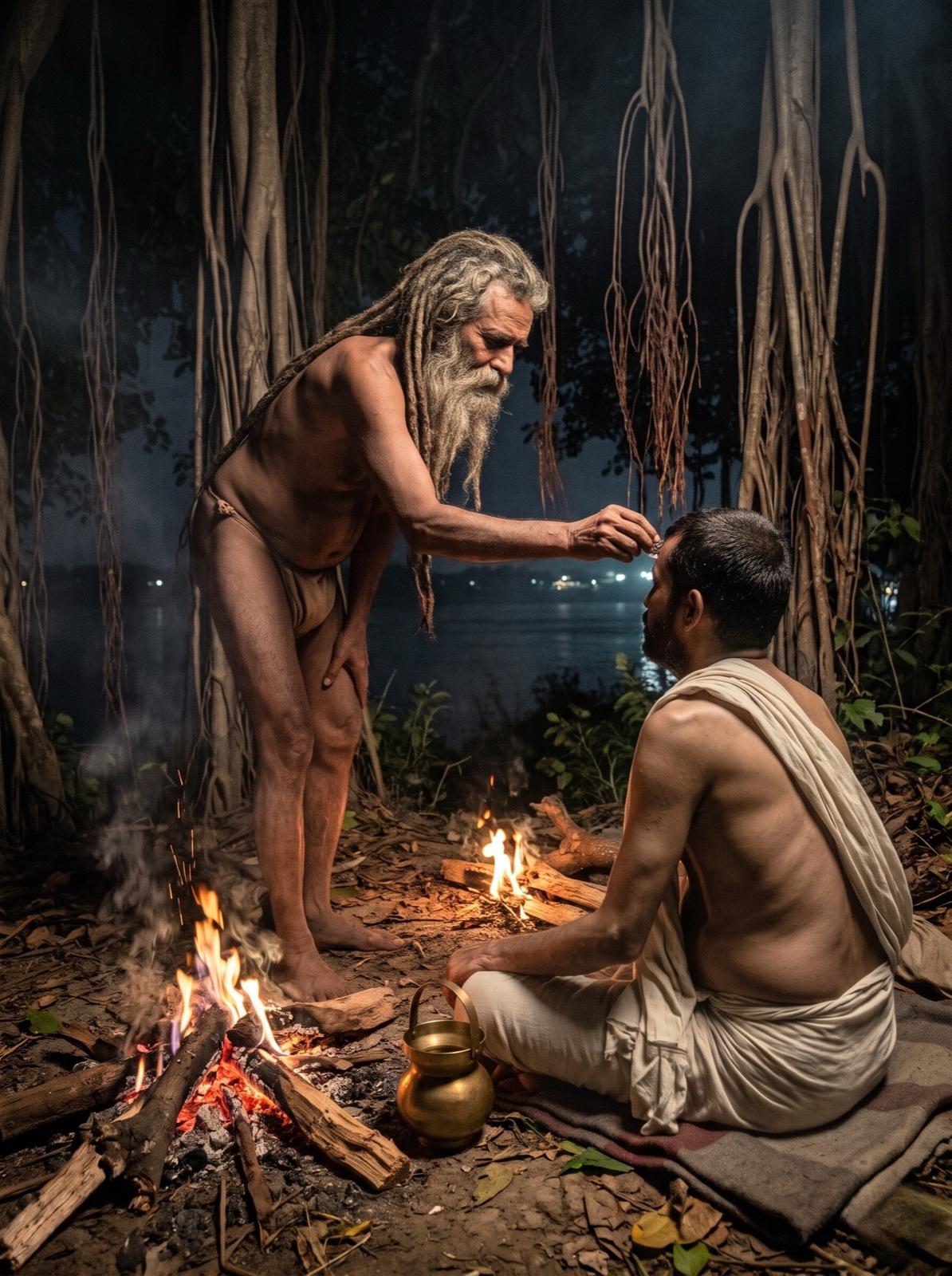
Almost despairing, Sri Ramakrishna opened his eyes and said, “No, it cannot be done; I cannot make the mind free from functioning and force it to dive into the Self”.[3] Totapuri scolded him severely and responded with “very excitedly” defiant urgency: “What, it can’t be done!”[3] Then Totapuri took a broken piece of glass, “forcibly pierced with its needle-like pointed end on my forehead between the eye-brows and said; ‘Collect the mind here to this point’.”[3] With that firm determination, Sri Ramakrishna sat for meditation again. When the holy form of the divine Mother appeared as before, he “looked upon knowledge as a sword and cut it mentally in two with that sword of knowledge.”[3] Then “There remained then no function in the mind, which transcended quickly the realm of names and forms, making me merge in Samadhi.”[3]
The outward signs and the duration of the Nirvikalpa Samadhi are described through Totapuri’s own examination and the later attempt to bring the Master back. Totapuri, “filled with doubt,” examined the state minutely, checking whether the heart was beating and whether “the slightest breath was coming out of his nostrils.”[4] He touched Sri Ramakrishna’s body, which was “in a steady posture, like a piece of wood, firm and fixed,” and found “no sign of any change or modification, nor was there any return of normal consciousness.”[4] Overwhelmed with joy and astonishment, Totapuri cried out, “Is it divine Maya? Is it in truth Samadhi? Is it the Nirvikalpa Samadhi, the ultimate result attained through the path of knowledge spoken of in the Vedanta? Ah, how very strange is the Maya of the Divine!”[4]
After that, Totapuri undertook “the process of bringing the disciple back to the consciousness of the external world.”[4] The narrative preserves the atmosphere of that attempt: “Profound sounds of the Mantra, ‘Hari Aum’, filled the land, water and sky of the Panchavati.”[4]
Sri Ramakrishna’s own description of Nirvikalpa Samadhi clarifies what was meant by “complete oneness” and what it entails for mentation. In explanation given as a spiritual teacher, he defines Nirvikalpa Samadhi as “To bring the mind to the state in which it is completely freed from all mentations.”[5] When asked what mentations are, he answers: “All the mental modifications such as the perception of the objects of the external world consisting of sights, tastes, etc., feelings of pain, pleasure, etc.; imagination, discussion, inference, etc., and desires, such as ‘I will do this’, ‘I will understand that’, ‘I will enjoy this’, ‘I will renounce this’, and so on.”[5] This is the inner meaning of the state in which the mind’s modifications are stilled.
The reminiscence also preserves the way the Master’s body appeared during the Nirvikalpa Samadhi and how Totapuri verified it. After the Master entered Samadhi “in the manner mentioned above,” Totapuri “remained sitting for a long time beside the Master,” and then, “coming out of the hut silently, he locked the door up lest some one should enter the hut without his knowledge and disturb him.”[6] Totapuri sat under the Panchavati awaiting the Master’s call.[6] Days passed into night, and “at the end of three days,” when Totapuri did not hear the call, he entered the hut and saw that the Master was “sitting in the same posture in which he had left him.”[6] There was “not the slightest function of the vital force in his body,” while “his face was calm and serene and full of effulgence”.