


Introducing the concept
When we say ‘I’, what do we typically mean? We usually think of our thoughts, our feelings, our emotions, our sensations, all of these internal states put together makes the ‘I’. Things in the external world are shared amongst all of us - we can all see these physical objects and engage with them; but the internal world is private to you - nobody else can see the images you are having in your mind right now, nobody else can feel the sensations you are having right now.
When we make the separation between ourselves and the rest of the world, we place the entirety of the internal world into the ‘I’ side of the divide - our internal states constitute our personality, our internal world provides us our sense of identity.

All of our private internal experiences are often clubbed together loosely under the term ‘mind’. But all schools of Indian philosophy have very systematically examined our internal world, and have come up with clear distinctions between different aspects of what we loosely call ‘mind’. Let us examine these classifications.
Going a little deeper
In Vedanta, there are three aspects to our bodies - the physical body, the subtle body, and the causal body. We can consider these are three sheaths or layers covering our real Self. The outermost layer is the physical body, the sthoola sharira, which is what we usually mean when we casually use the word ‘body’ - our limbs and organs and so on. But underneath this is another layer where all of your thoughts, ideas, sensations, emotions and everything else that comprises your inner world are located - this is called the subtle body, or the sukshma sharira or linga sharira.
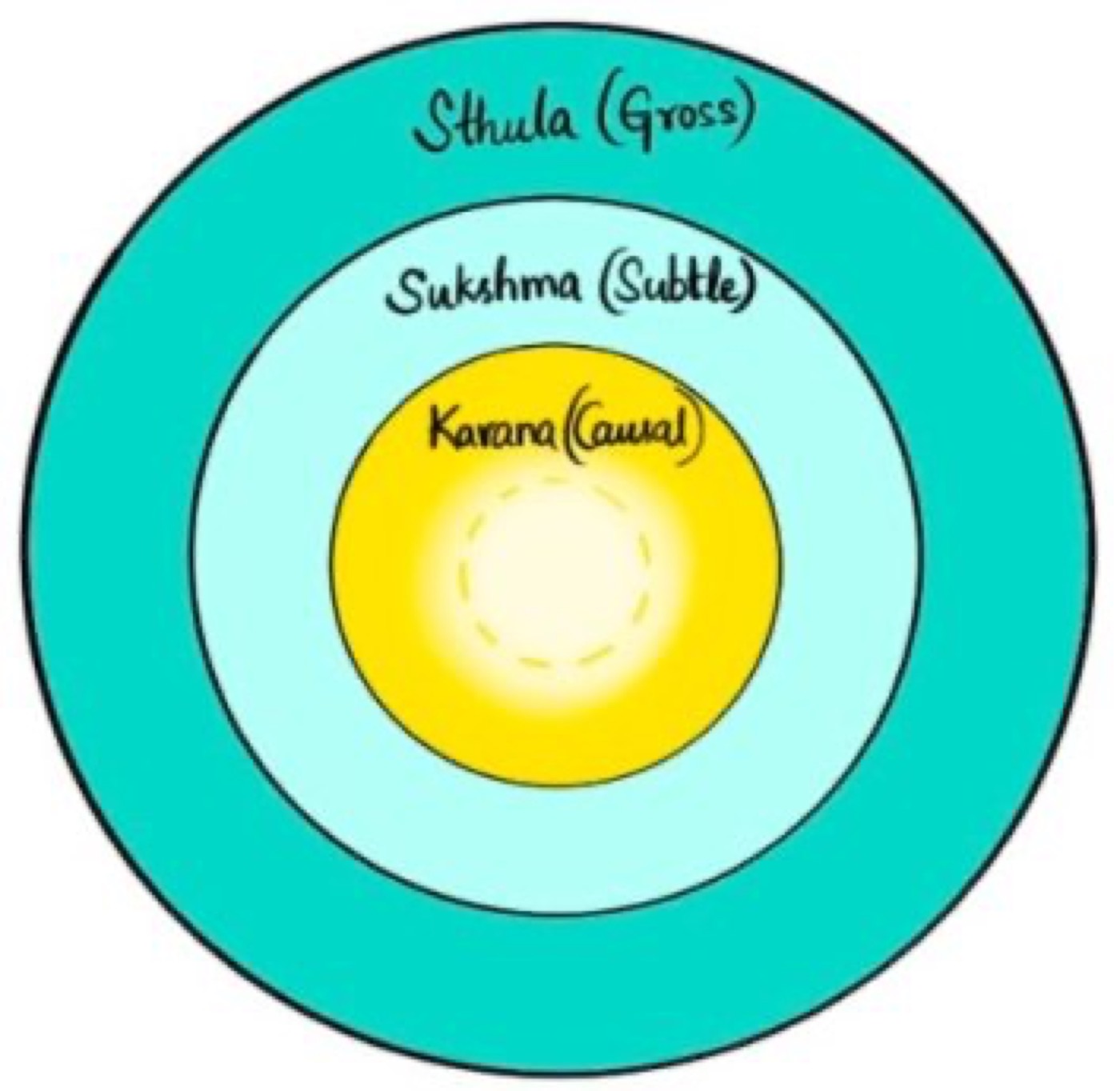
A small diversion to make an important point - please note that terms such as ‘layers’ and ‘underneath’ are used for ease of understanding, as conceptual frameworks - in reality, as you will learn by exploring this lexicon, the physical and subtle bodies are illumined by consciousness all at once, and all ideas of separation and classification melt away. But more on that in other pages; let us get back to the linga sharira.
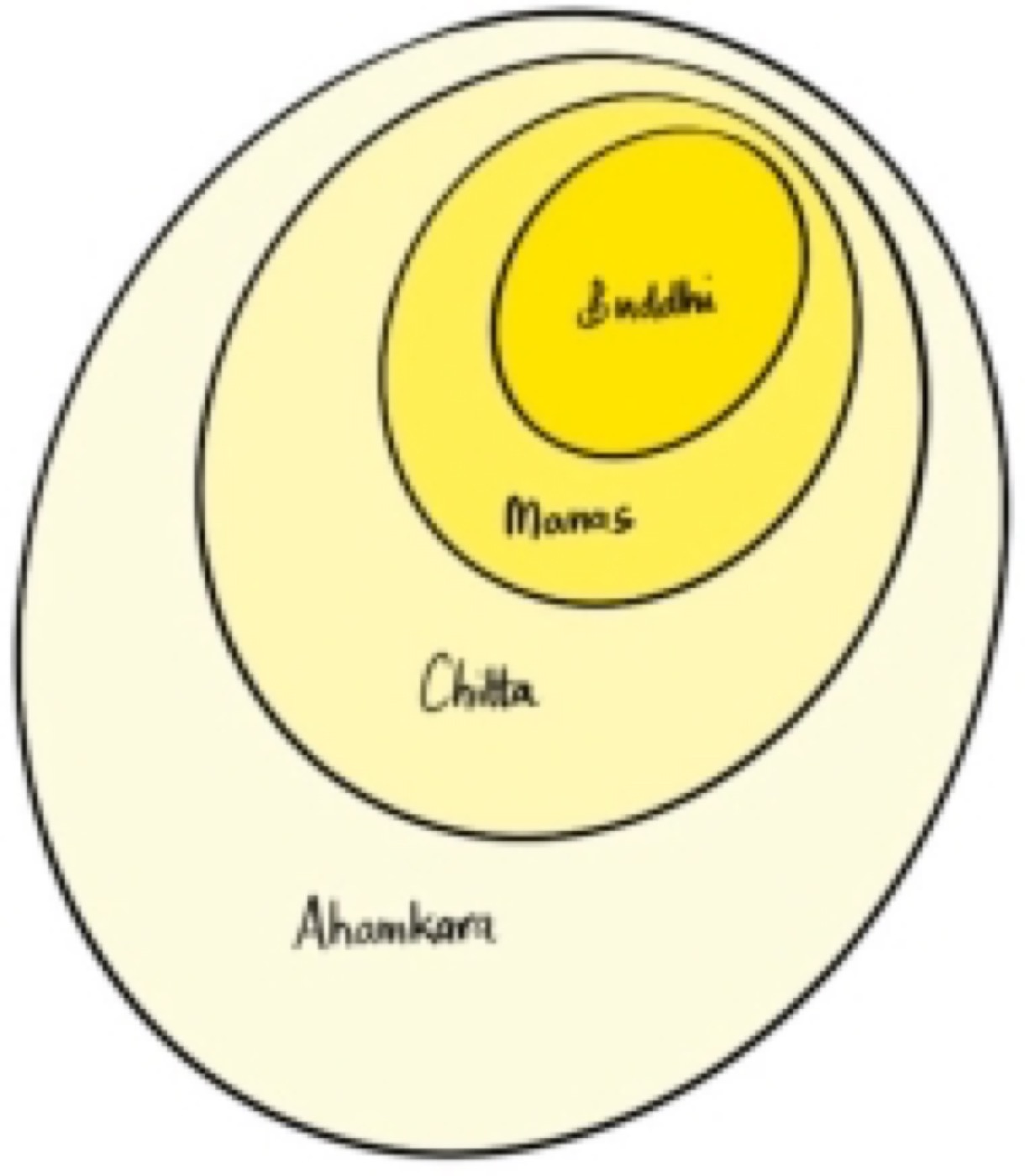
The linga sharira comprises the following parts - the five organs of perception, the intellect (Buddhi), the mind (Manas), the mind-stuff or memory (Chitta), the egoism (Ahankara), and the five vital forces (Prana, Apana, Vyana, Udana, Samana). 19 components in total. Out of these, the 4 components of Manas, Buddhi, Chitta, and Ahankara together are called the Antahkarana (inner instrument)[1].
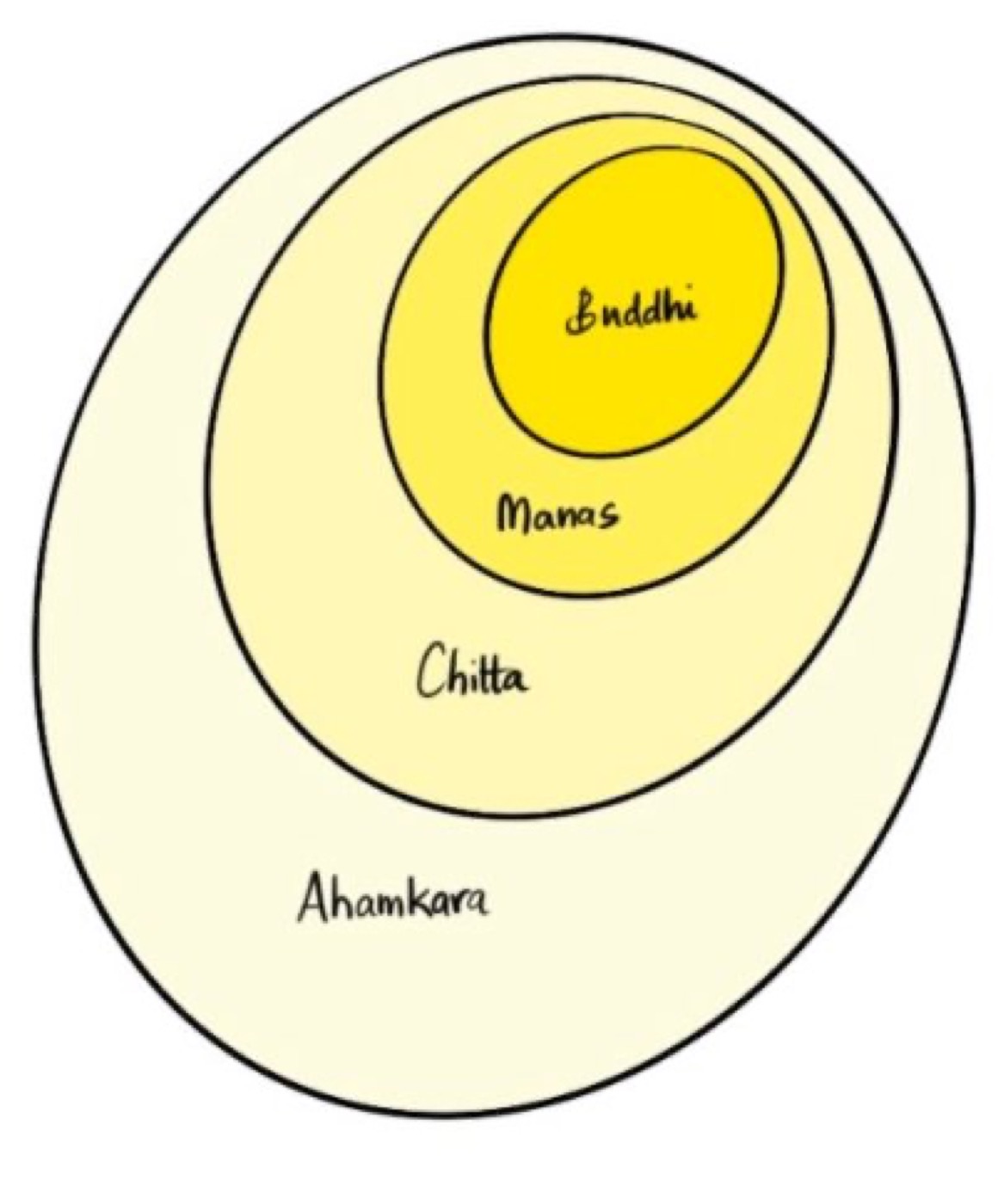
In casual parlance, and even in serious modern scientific literature, the four components or functions of the Antahkarana are clubbed together into the term ‘mind’. But separating them out conceptually, as is done in Vedanta and other schools of Indian philosophy, helps us understand ourselves better. Let us examine the functions of the Antahkarana. We will be referring to the definitions provided in Sadananda’s Vedantasara.
Buddhi (Intellect)
The intellect (Buddhi) is that aspect of the Antahkarana that determines.[2] Multiple data points are presented to it, and the buddhi makes the final decision. The buddhi decides what the real nature of the object being perceived is; the buddhi looks at all the information and decides the course of action to be taken.
You might be seeing splotches of yellow and black in between the leaves in a forest - could it be a tiger behind those bushes, or is it just a play of light? It is the buddhi that weighs the possibilities and finally decides whether to run for safety or not. It is the buddhi that gives you a sense of control over your choices. The buddhi is the inner voice or will that tries hard to persuade the mind (manas) to do the right thing at each point of time[3].
Think back to all the decisions you took today, from small to big; can you spot the role of the buddhi in these decisions?

What thoughts come to your mind when you see this image?
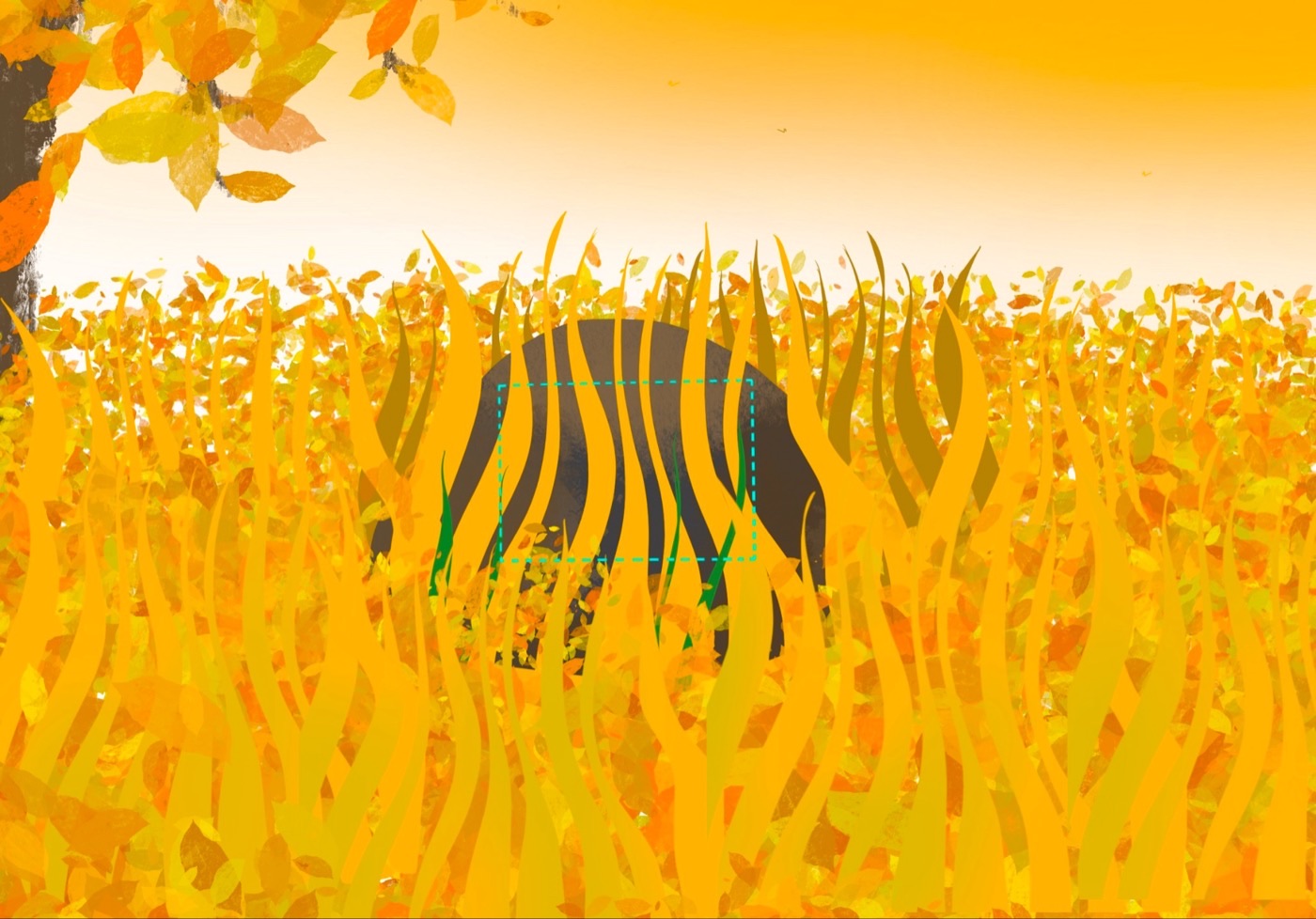
What you saw is a picture of a rock behind dry grass. The highlighted portion within dotted lines is what you noticed, yet did you also feel it was a tiger?
Manas (Mind)
The manas is that aspect of the Antahkarana that involves Sankalpa and Vikalpa[4]. Sankalpa indicates all the thoughts you are having related to a particular subject matter. Let us take the same example from above, where we were trying to determine whether the yellow and black patches were from the body of a tiger. When we look at the yellow and black patches, we not just have the visual signals coming in but also auditory signals - perhaps there is a rustling of leaves? - and smells, etc. All of these various signals or impressions provide partial views into the same object - the manas stitches these separate but related signals together and places them before the buddhi, so that the buddhi can take identify the nature of the object (i.e. is it a tiger or just the play of sunlight and shadows?[5]).
The final determination of whether or not it is a tiger, and the decision on whether to run for safety or not, is taken by the buddhi; but until the decision is taken, all the thoughts related to the various possibilities, the pros and cons of the situation - these constitute the Sankalpa aspect of the manas. Thus it is the manas that functions when you are still determining the course of action; the buddhi ends the stream of thoughts by taking a final decision.
The Vikalpa aspect of manas indicates the hundreds of unrelated, unfiltered thoughts that pour into our minds all the time, including imaginary scenarios, fears, doubts. ‘What if I show up to the exam hall and forget everything I studied?,’ ‘What if she makes fun of me?,’ ‘What if I were batting for India with 6 runs to get off 1 ball?’- the constant stream of such thoughts, often relating to imaginary scenarios, is the vikalpa nature of the mind. If you close your eyes right now and try to listen to your thoughts, you will hear this constant vikalpa chatter[6].
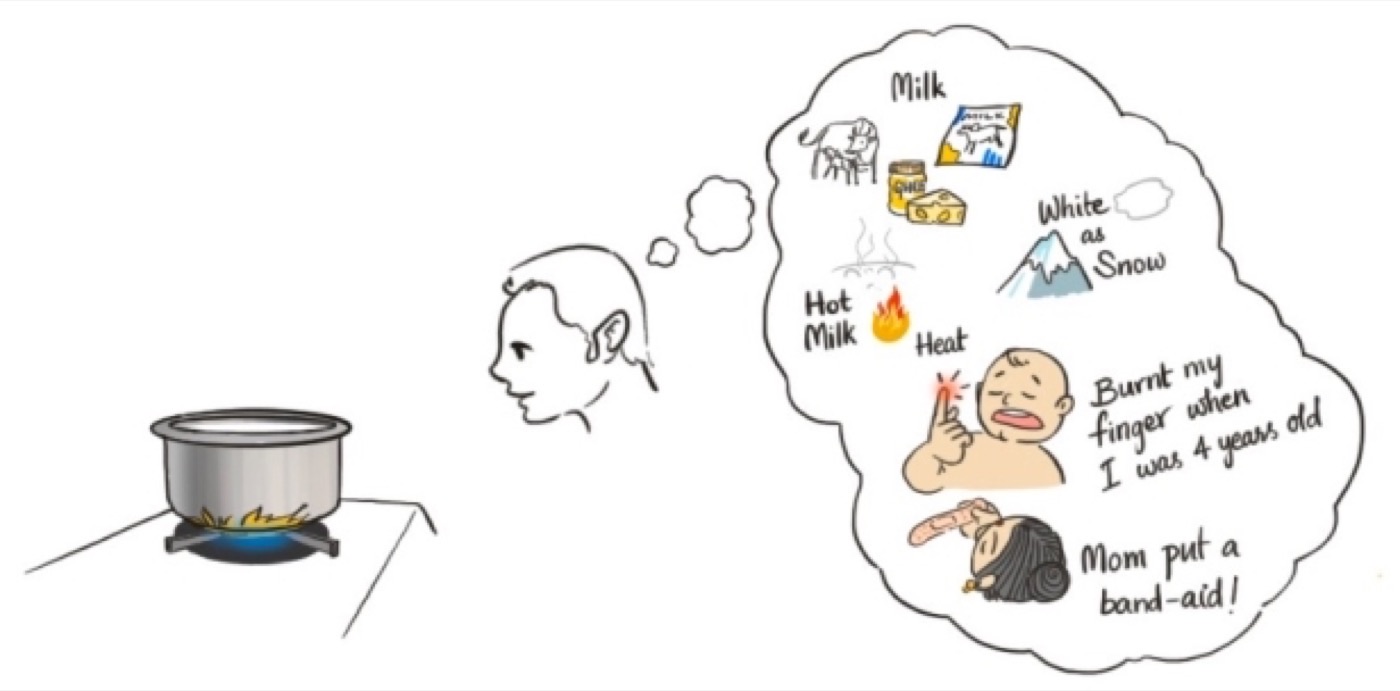
Watching hot boiling milk, this person is recollecting consciously and unconsciously many thoughts and memories such as - milk, cow, calf, cheese; milk’s color - white, as white as snow; milk is boiling - and it reminds him of heat, a memory of how painful it was when he burnt his finger when he was 4 years old, recollecting how his mom put a band-aid on his finger with love and affection.
The manas is thus the sum total of all our thoughts - positive and negative thoughts, thoughts in our control as well as thoughts that walk in uninvited. As you will find by exploring this Lexicon, an important step in the spiritual journey is to bring the mind under your control - by directing it to your intended destination, to quieten the constant chatter of the manas.
Chitta (Mind-stuff)
All your mental images, memories, raw emotions - these constitute the chitta - the ‘stuff’ of the mind. Just as there is an external world that you are aware of right now, is there not also an inner world that you are simultaneously aware of? This inner world is filled with visual images, colors, textures, memories, feelings - all of these are the raw materials or the fundamental fabric of our inner experience; all of these constitute the chitta aspect of the antahkarana.
Prior to the buddhi determining a final course of action, and prior even to the manas organizing signals and memories into a stream of thoughts, it is the chitta that is at play. When you are deciding whether to pluck a rose or not, the manas is at play; when you finally decided to pluck it the buddhi is at play; but during all this, the redness of the rose and the fragrance of the rose are manifestations of the chitta.
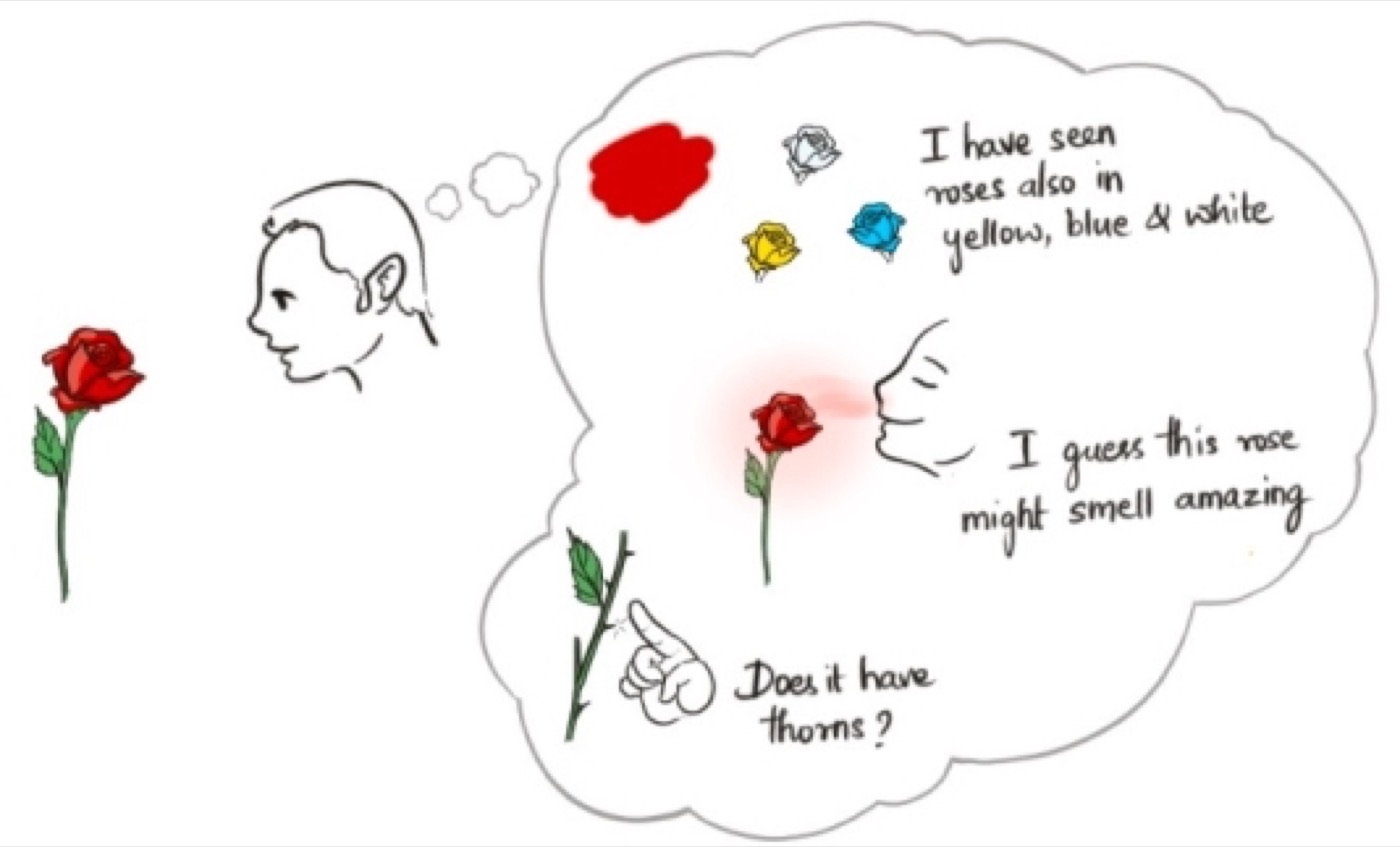
The person looks at a red rose in front, there is a stream of memory that floods through - his memory of roses in other colors such as yellow, blue and white. He recollects the sweet scent of roses from earlier experience, and doubts whether this rose will have that smell and also the thorns its stem typically has.
In short, the chitta is the constant movie that is playing inside your mind, the magnificent play of images and sensations and memories that only you are witness to.
Ahankara (Ego)
The ahankara is that aspect of the antahkarana that provides unity and ownership to all the activities of the manas, chitta, and buddhi. When the buddhi identifies an object, you feel that ‘I know the object’; when a sense of happiness shows up in the chitta, you feel ‘I am happy’; when the manas deliberates upon the pros and cons of a situation, you feel ‘I am thinking’. This sense of agentship or doership that we all have, this sense that there is an ‘I’ that is controlling the various actions of the mind, this ‘I-sense’ is called the ahankara[7].
By stitching together all the various mental activities under the umbrella of ‘I’, the ahankara provides coherence and structure to all our thoughts, feelings, emotions, sensations. The ahankara or the ‘I-sense’ is something that attaches itself to every other thought. It is constantly present but hard to focus on and pin down; we take it for granted that ‘I’ am thinking and ‘I’ am feeling and ‘I’ am doing something.
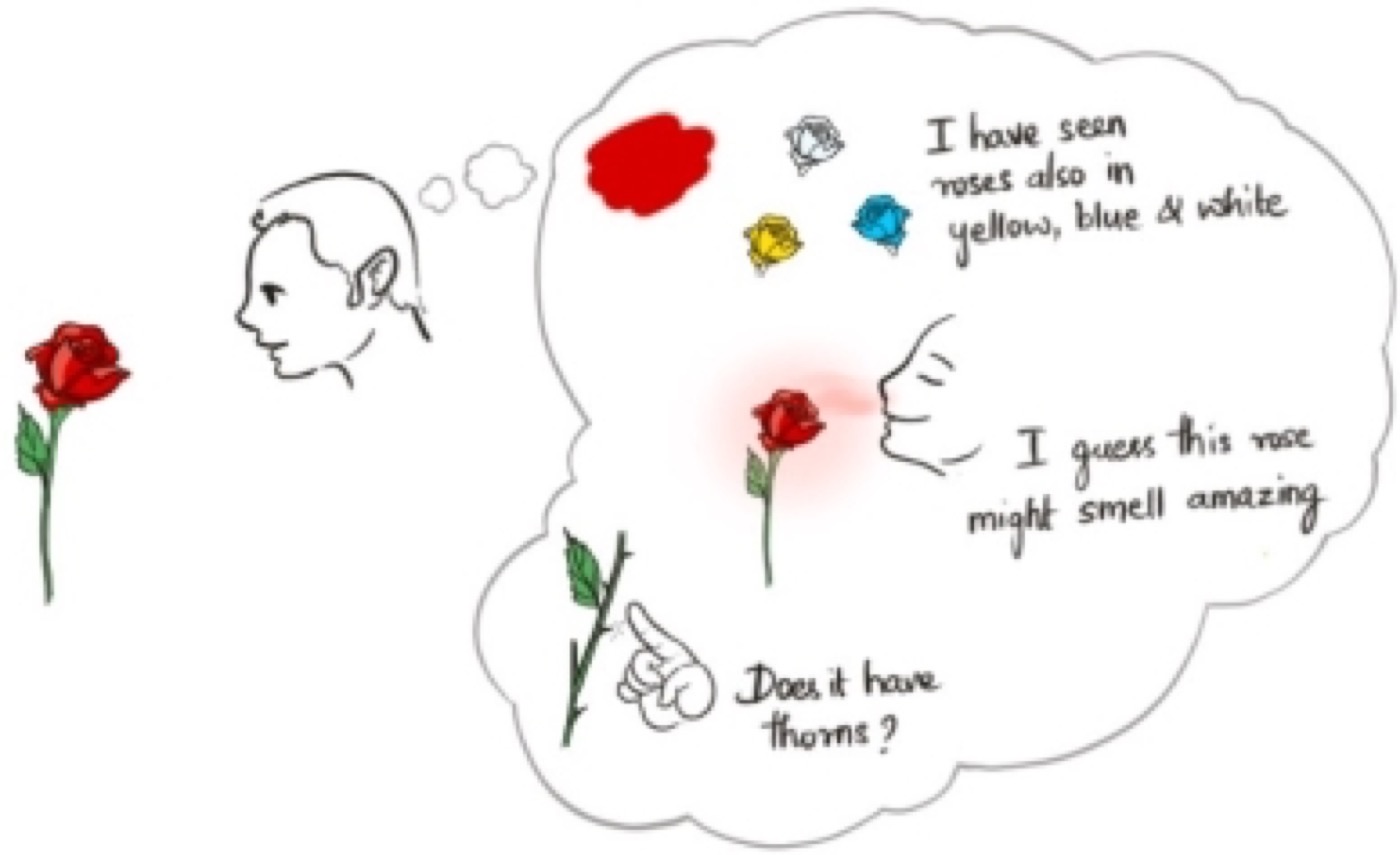
In the left image the person views the rose, various thoughts and unorganized memories flood in from his Chitta. As per the context, the Manas chooses some logical questions. Say the person wants to touch the stem, the Manas might ask ‘Does it have thorns?’ - which is a question based on an earlier experience. But by observing the rose stem in front of him, the Buddhi notices and decides there are no thorns in the stem now - thereby the Buddhi helps him make a decision that he can touch the stem without any concern. This whole process is claimed by the Ahamkara as ‘I made the decision and I am going to touch the stem’.
One of the main pathways to a full understanding of the teachings of Vedanta is to sharply examine this ‘I-sense’ - What is the ‘I’ really pointing to? Where is this ‘I’ present? Can I separate my other thoughts from this ‘I-sense’ and focus on just the ‘I’? What is the real nature of this ‘I’?
Reflect on this
So far we seem to have assumed that there is a very clear difference between our inner world (antahkarana) or our ‘subjective’ world (the world that only we have private access to) and the external ‘objective’ world. For the purposes of understanding the finer functions of antahkarana, this was a useful assumption. But think about it - is there really a difference between the internal and external worlds?
You might be seeing a cup right now (i.e. an object in the ‘external world’) and you might also be imagining another cup in your mind (i.e. an object in the ‘internal world’) - it might seem obvious that the first cup is real - after all, you can touch it and lift it - while the second is just a mental image. But think about it - even when you are seeing the first cup, are you not seeing a mental image? The cup itself does not come and sit inside your head, does it? Even if there is actually a cup ‘out there’, what you are seeing is a mental image of a cup. Is it not the case that everything we are aware of is a mental image? In which case, where is the dividing line between the antahkarana and the outside world?
If you are confused, do not worry - things will get clearer; continue exploring the Lexicon and do take the time to reflect on the concepts you encounter.