Introducing the concept
One of the central questions in philosophy is - ‘How do we get our knowledge of anything?’, or simply ‘How do we know about anything?’ Associated with this is the question - ‘How do we know that our knowledge is true?’ Unless we can answer this question satisfactorily, we will not be able to proceed in our enquiry. Without clear ways of separating correct from incorrect knowledge, we will not know whether any pathway we are taking is bringing us closer to the Truth.
One of the ways of knowing something is experiencing it - when you see something, or hear something, or touch and feel something. How do you know there is a fire burning in front of you? Because you can see the orange flames, because you can hear the crackling of the flames, because you can feel the heat emanating from the flames. This is knowledge via experiencing, via perceiving the object of knowledge, and this is called pratyaksha.
Sometimes you cannot see the fire directly (or hear it or feel it directly), but you can see smoke coming from the distance. The smoke indicates that there is a fire burning. This is called inference, or anumana, and this is another valid way for gathering knowledge. To learn about the valid modes of gathering knowledge in Vedanta, read our page on Pramana.
But now let us take our experience of an object itself and probe it further. When we see fire, what is really happening? Does the fire come and sit inside our eyes? Of course not. What we are experiencing is the image of ‘fire’ in our minds.
This is simply a statement of fact. When we say we are experiencing something, what we are experiencing is a mental modification (a vritti). We assume that this vritti somehow corresponds directly to the object we seem to be perceiving. What is happening, you might say, is that light is bouncing off the object and hitting your retinas, which in turn trigger the photoreceptor cells to signal a signal to your brain, which recreates the image of the object in your mind.
That might seem to be a reasonable explanation, but do you have any way of saying that is really what is happening? All you can know is that you are aware of something - whether that corresponds to an object ‘out there’ or not is something you can have no way of saying anything about, since anything that you say or know is again a modification of the mind! In other words all knowledge we have of objects in the world is indirect knowledge. Even when we think we are directly perceiving an object, We are forever looking at the ‘world’ via the filter of our minds. Dwell on this for some time.
Going a little deeper
Rene Descartes, one of the major figures in modern Western philosophy, took the question of ‘How can we know?’ very seriously. He wanted to place knowledge on a firm footing. He embarked on what is now called the project of Cartesian Doubt.
Let us imagine there is a deceitful demon, Descartes said, that is super powerful and has trapped us in this make-believe world. For those of you who have watched the movie The Matrix, you can replace the demon with the super-intelligent machines who enslave humans within the computer-generated virtual world. What you see in front of you right now, in this scenario, could be an illusion cast by the demon - or simply a computer simulation. You think you are looking at a table in front of you, but the demon is deceiving you; perhaps there is no table at all.
Go back to what we said earlier about how we can never really perceive any object directly, without the instrument of our minds. So it is indeed possible that there is a demon projecting these images onto our minds, forever blocking our access to the ‘real’ world.
In such a scenario, is there anything that cannot be doubted? The project of Cartesian Doubt proceeded by examining everything that we think we know and ask about - ‘Can I be sure of this? Is there a chance that I am being deceived by that demon? Is there even a small possibility that this knowledge can be doubted?’ If the answer to these questions is ‘Yes,’ then that knowledge should be set aside, and we must proceed further to examine other things that we claim to know.
What Descartes found while carrying out this mental experiment, is that there is nothing - no objective knowledge - that cannot be doubted. Everything we perceive, everything we know, could be magic tricks staged by that demon.
Everything except one thing.
When I perceive a tree, the ‘tree’ could be a magic trick, or a computer program, or a dream, or a hallucination. But the ‘I’ that is perceiving the tree undoubtedly exists! The Self that is witnessing the tree - whether it is a ‘real’ tree or an ‘illusory’ tree - is indisputably real.
Our perception of anything presupposes the existence of the Self. In other words, without the Self, there is no perception, no inference, no knowledge of any sort. Even false knowledge requires the existence of the Self!
Even if I am being deluded about the nature of the world around me, the fact that there is a Self being deluded cannot be doubted.
Descartes reached the end of his project - the one ‘thing’ that cannot be doubted is the Self. If I am thinking anything at all, if I am aware of anything at all, if I know anything at all, it indicates beyond a doubt that I exist.
Tying the threads together
But where is this Self? Can you spot it? Can we see or experience the Self? Wherever we look, we find only body or thoughts; those are not the Self. However subtle we go in our inquiry, we only find more thoughts, more objects; all of these objects change, all of these objects come and go, so they cannot be the Self. Read our page on the Atman for a systematic inquiry into the Self.
Nowhere we look are we able to find the Self. Does that mean that the Self does not exist? Of course not! We just saw that the Self is real without a doubt. But then how is it that we cannot spot it wherever we look? Because it is the Self itself that is looking. This is a crucial insight in Advaita Vedanta; dwell on it until you ‘get’ it. Do not proceed to other concepts until you have understood this.
You are looking for things in the objective world, and you will never be able to find the Self there. The Self is the Subject, it is the Witness. When you are searching for the Self, it is indeed the Self itself that is searching!
So while you will not be able to find the Self wherever you look, everything that you are looking at is indisputable proof of the Self. The entire Universe is a reflection of the Self.
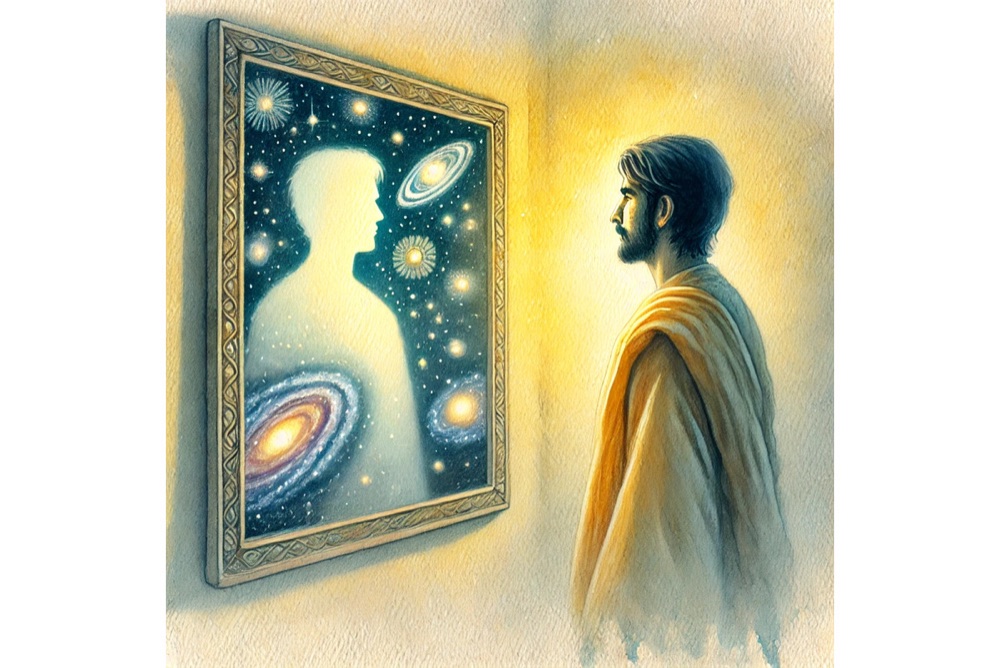
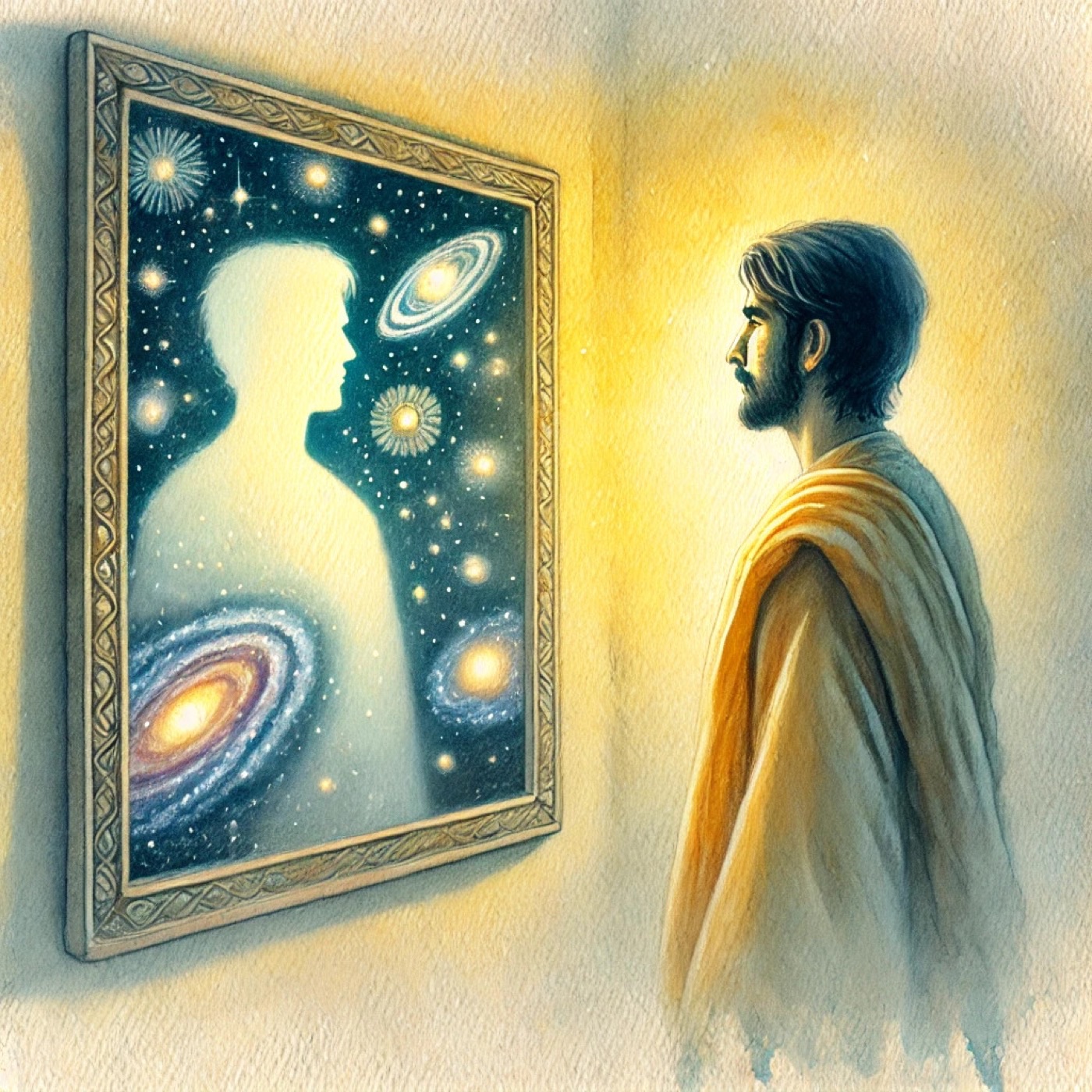
You can never directly see your face; you can only see reflections of your face. Just like that, you can never ‘see’ the Self directly, but this magnificent World is a reflection of you, the Atman. When you are seeing anything at all, what you are seeing is you, the immortal Atman.
‘Atmaiva sarvam!’ writes Shankaracharya, ‘All this is the Self indeed![1]’
We saw earlier than even ‘direct’ perception of objects is indirect knowledge - it is knowledge filtered via our minds. All knowledge we can gain, about any object, is indirect. The only direct knowledge we have is the knowledge of the Self. Atmajnana (knowledge of the Self) is prathyaksha (direct) or aparoksha (immediate).
In every instance of indirect knowledge, the aparoksha jnana of the Self shines through.
This aparoksha jnana of the Atman is the solid, unshakable base on which the philosophy of Advaita Vedanta rests. If the only thing we can be sure of is that ‘I exist’, then, Advaita Vedanta says, let us drop everything else that can be doubted and direct all our attention to this ‘I’, let us try and truly understand who or what I am.
Reflect on this
Pick up any object from around you. You can see it, you can feel it in your hands. It seems ‘real’. It seems like you are directly experiencing the object, and thus it seems like your knowledge of this object is certain.
But look at the object - let us say it is a cup - and ask yourself - what is it that you are seeing? Are you not, quite simply, seeing an image in your mind that you are labeling as ‘cup’? We assume that this image represents a real cup ‘out there’. Whether or not this assumption is valid, the fact is that we can only ever have access to the mental image - to the appearance - of the cup; we can never have direct knowledge of the cup. We can never know what the cup is ‘in itself’, without the filter of our minds.
Pick up various objects and examine them in this way. Once you truly realize the indirect nature of the knowledge we have of all objects, you can gently pull your attention backwards to the Self that is looking at these objects.