Introducing the concept
The Avastha Traya Viveka is a simple but powerful framework in Vedantic inquiry, using which we can examine our common, everyday experiences - whatever experiences you are having right now - to get a deeper understanding of the Ultimate Truth.
The universe of all possible experiences we can have can be split into 3 categories or states - the waking state (Jagrat avastha), the dreaming state (Swapna avasatha), and the deep sleep state (Sushupti avastha). At any point, you will be in one of these 3 states - there is no other state possible. In each of these states, there is an experiencer and there is an experienced world.
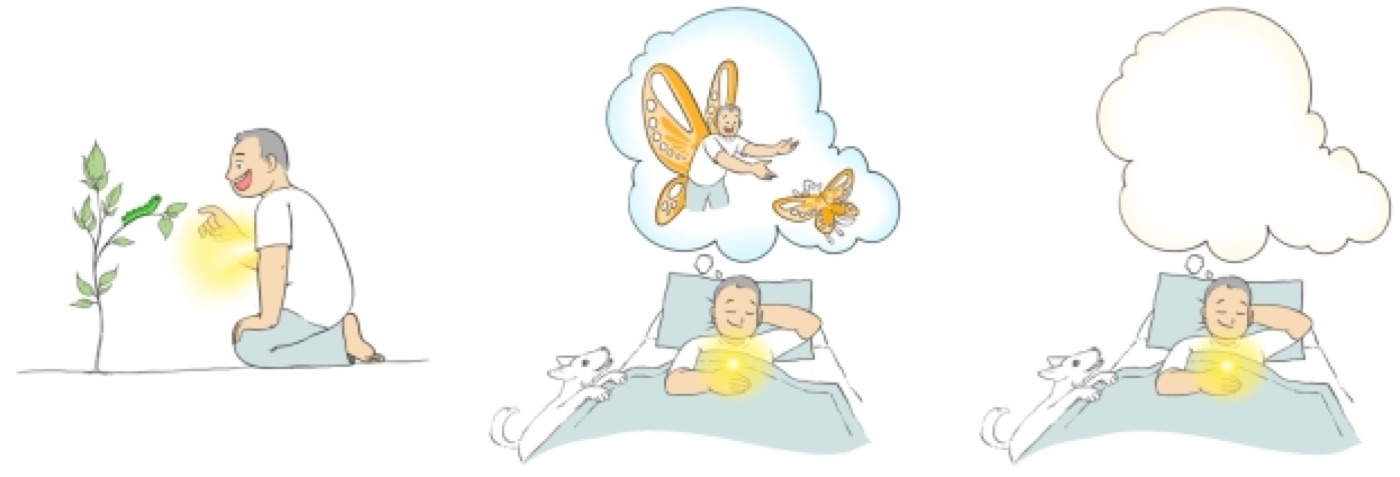
The waking state (Jagrat avastha) is what you are in right now (we hope!). You have this sense of ‘I’ that is experiencing the world. This ‘I’ or experiencer of the waking world is called Vaishvanara or Vishva in Vedanta[1].
When you fall asleep later tonight you might move into the second state, the world of dreams (Swapna avastha). There is an entire dream world that your mind conjures up, and there is a sense of ‘I’ that is experiencing the dream. This dream ‘I’, the experiencer of the dream world, is called ‘Taijasa’. You consider your dream state to be unreal or ‘less real’ than your waking state, do you not? You as the dreamer - you in the Taijasa state - might have experienced intense joy and suffering, but all of this falls away when you wake up. The waker is able to, for the most part, brush aside their dream experiences and move on with their ‘waking’ day.
At some point during your sleep, you will slip into deep sleep, where the world of experience seemingly shuts down completely. This is the third state of experience, called Sushupti avastha. And the ‘I’ that is experiencing the deep sleep is called Prajna. In Advaita Vedanta sushputi is a sharp pointer to Ultimate Reality; understanding what is happening during deep sleep is important in gaining an intuitive understanding of Advaita Vedanta.
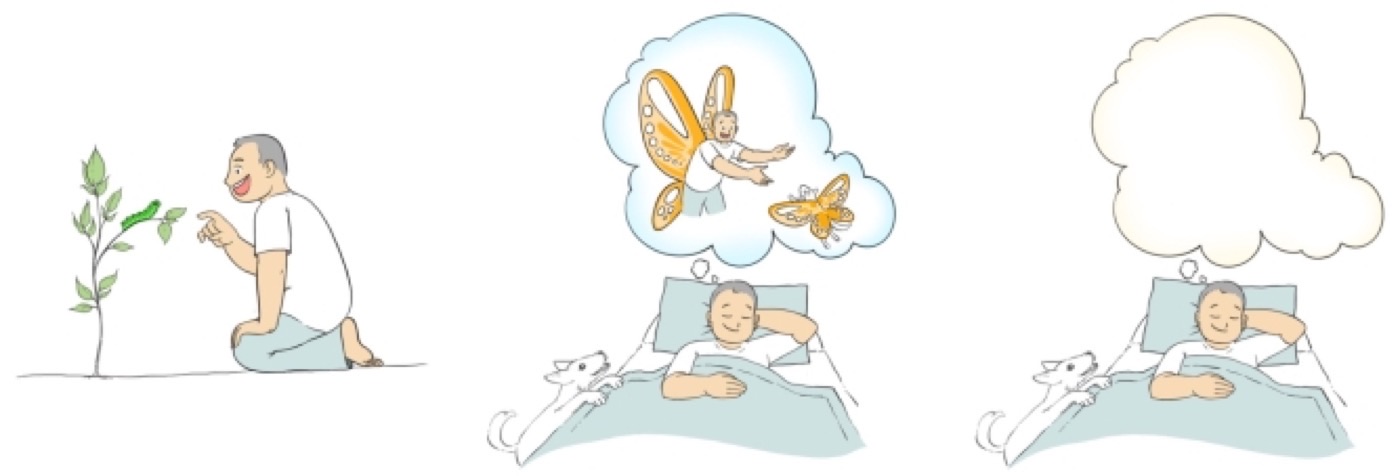
But if there is nothing to experience, why are we bringing in the concept of the experiencer Prajna, you might ask. Why is deep sleep being considered a state of experience - is it not a lack of experience, a blankness? Do we not know about the deep sleep state only after we wake up, when we look back and infer what happened? These are very important questions and we will address them on this page.
So these are the three states of our being - Jagrat, Swapna, Sushupti. The path to realizing your true nature is by looking for the common thread that stitches these states together. Let us go deeper.
Going a little deeper
We mentioned that there are different names given to the experiencer in each of the 3 states (Vishwa, Taijasa, Prajna). Does this mean that there are three different witnesses that are disconnected from each other? Think about it, when you go to sleep, do you disappear, for a new person to emerge as the dreamer. And then, when you wake up again, does the dreamer disappear, only for you to come back again? Where could you possibly disappear to? And if you do disappear, how could you have come back? If there are indeed multiple different ‘people’ experiencing each of these states, what is holding them together?
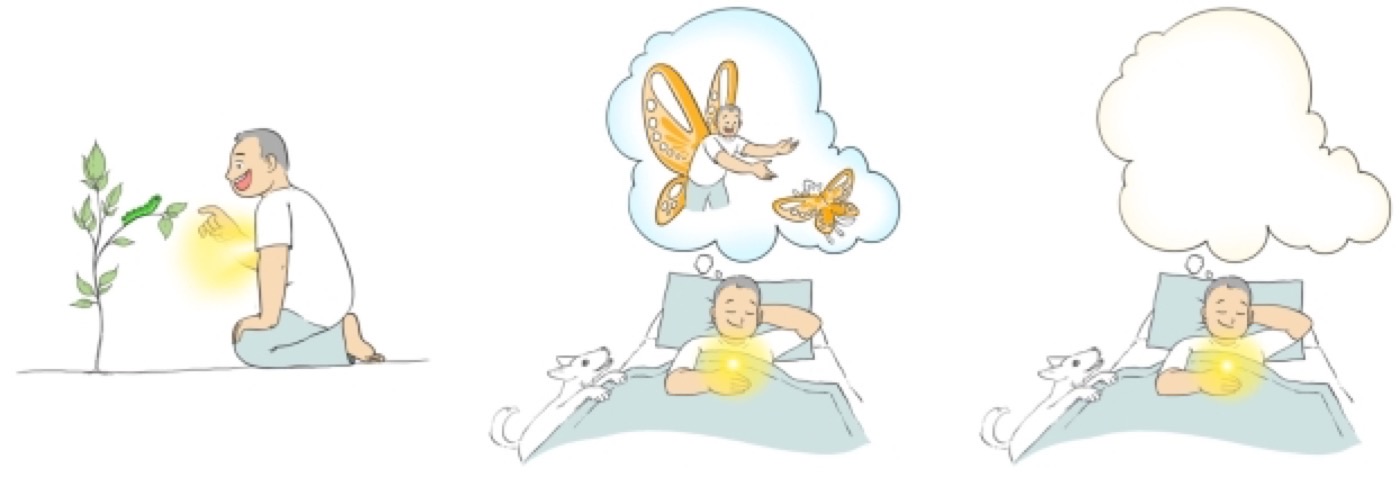
Ask yourself this - when you wake up from sleep, do you not feel that ‘I was asleep’? Across multiple cycles of waking and sleeping, isn’t there a unity of being - you are going through these cycles of waking and sleeping; there is a ‘you’ that stays steady through all these transitions between the three states. ‘I am awake, I slept, I dreamt’ - there is an ‘I’ to which all these worlds are appearing. We need to examine the nature of this ‘I’, this connecting thread between the three states - that is the central practice in Advaita Vedanta. But before we do that, let us place two more ideas for you to think about, two questions that might have struck you.
Are there really three different states?
Firstly, while we are categorizing these as three separate states, is it not the case that it is only the waking state that you are aware of while it is happening? Both the dream and the deep sleep states are inferred from the waking state, while you look back and recollect what happened while you were asleep.
Furthermore, can a clear line of distinction be drawn between the dreaming and waking states? We go into this question in depth in the page on Maya. Can you be sure that what you consider to be ‘waking’ now is not just a dream? You might find the world around you to be very ‘real’, no doubt, but what if you wake up a few minutes later and realize you were just dreaming everything? Thus, while the distinction of the three states is seen only from the waking state, whether you are in the waking state itself is something that cannot be convincingly determined.
Sri Ramakrishna had a nice story to explain this -
Once, a woodcutter had fallen asleep in the middle of a hot day. Someone saw him sleeping and jerked him awake. The woodcutter was furious. ‘Why did you wake me up?’ he asked, ‘I was dreaming that I was a great king and the father of seven beloved children. You have destroyed my world of joy!’
‘But that was just a dream!’ the other person, who woke up the woodcutter, protested.
The woodcutter replied, ‘While I was dreaming, I was as truly a king as I am a woodcutter now.’
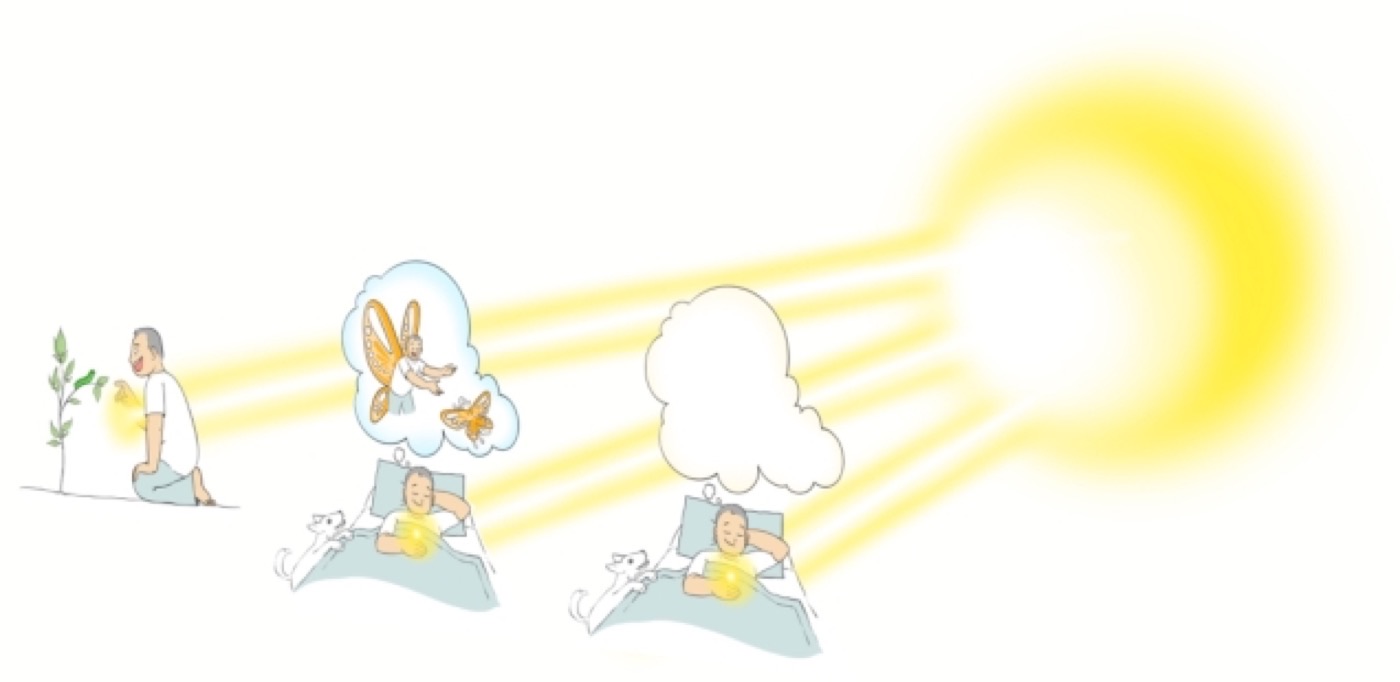
All we can say, then, is that we are experiencing various phenomena, that there is an ‘I’ that is aware of various experiences, regardless of how you want to categorize it across states. The state categorizations are merely a useful way of organizing our experience, but one need not take the state distinctions too seriously.
If this is confusing, don’t worry. We will tie the threads together in the last section. You can come back and revisit this page later, after you have had the chance to reflect.
How is deep sleep a state of experience?
When your mind shuts down in deep sleep, is there not a lack of experience? Why then is deep sleep considered a mode of experience? Is it not the case that consciousness disappears in Sushupti or deep sleep?
To answer this, one must understand what Consciousness really is. In Advaita Vedanta, Consciousness is the pure Subject to which everything appears - all objects, all concepts. We suggest you read the page on Chit (Consciousness) before proceeding further on this page.
In deep sleep, let us assume that Consciousness shuts down completely. Then to whom or to what is the blankness of deep sleep appearing? This is a very important question for you to reflect on. ‘Nothingness’, ‘blankness’, ‘emptiness’, ‘lack of experience’ are all ideas and concepts - they are all part of the objective world, and thus they presuppose the existence of the Subject. Without a Subject that can objectify it, it makes no sense to speak of blankness or nothingness. As Vidayaranya Swami writes in the Panchadasi, ‘Even nullity requires a witness’ [Add footnote].
Thus the state of deep sleep is where the Subject, that is, Consciousness, experiences a blankness. As Swami Sarvapriyananda puts it elegantly, ‘Deep sleep is not the absence of experience, it is the experience of absence’.
We have introduced multiple different ideas, let us now bring them together.
Tying the threads together
What we have understood so far is that -
- The distinction between the states themselves are not ultimately real, and are just a useful framework to use, while in the waking state, to organize the seemingly distinct modes of experience we have.
Swami Nikhilananda writes, ‘All these experiences (i.e. the three states), in fact, belong to the waking state alone. That dreaming and deep sleep have different characteristics is known only in the waking state.[2]’
- There is a unity of experience across the three states; despite the apparent differences in the three states, there is a constant ‘I’ that remains across the states, so that we can say ‘I am awake now, and I was in deep sleep a few hours back’.
In Swami Nikhilananda’s words, ‘The states, no doubt, change, but an awareness underlies them in the form or the self or as expressed in the judgment “I am the perceiver”[3]’.
Thus the examination of the three states brings us to this simple formulation:
On the one side is Appearance, where we can club together the waking, the dreaming, and the deep sleep worlds - the conglomeration of the three states.
On the one side is Consciousness - the ‘I’, the witness, the Subject, the common thread across the three states.
Transcending the three states, yet present in and through all the three states as their substratum or witness, is Consciousness. This is called Turiya, The Fourth.
It is important to understand that one doesn’t need to move to any ‘fourth’ state to find Turiya; you do not need to go searching for Turiya anywhere. Once you understand what Turiya or Consciousness is, you will realize that it is Turiya alone that is present in all the three states. It is Consciousness to which the waking world, the dream world, and the blankness of deep sleep appears.
It is the ‘fourth’ when considered with respect to the three states, but Turiya alone is real, the three states being appearances of Turiya to Turiya. The three states are like mirages and Turiya or Consciousness is the sand - the real substratum - on which the mirage rests. When you sharply examine the three states, you find them melting away, leaving only Turiya, the light of Consciousness.
It says in the Mandukya Upanishad - ‘The essence of Consciousness manifesting as the self [in the three states]... This is what is known as the Fourth (Turiya). This is the Atman, and this has to be realized.[4]’
‘The realization of the self as Turiya destroys ignorance, desire, attachment aversion, etc. The gist of the teachings of the Upanishads is the identity of the self and Turiya.[5]’
You are the Fourth.
Reflect on this
The Avastha Traya Viveka is a tool that you can deploy over your regular, constant experiences. It is a framework that will help you to see the ‘Fourth’ - which is Consciousness, your own Self - as the common substratum or witness in all experiences. Whenever you get the chance, try examining your experiences using the framework provided. Use it to examine all three states -
While you are awake - take any object you are experiencing right now and ask yourself: ‘To whom is this appearing?’ Do this for other objects - both ‘external’ objects, i.e. physical objects and ‘internal’ objects, i.e. mental objects. Keep asking ‘To what is this appearing’? Sharply examine the answer your mind throws up. If the obvious answer is ‘The objects are appearing to me,’ then ask yourself what this ‘I’ is, or ‘To whom or what is this sense of ‘I’ appearing?’
Think back to when you were dreaming. There were objects that appeared to you in the dream too; just like the waking state, some of the dream objects seemed to you - while dreaming - to be external or physical objects, and some of the dream objects appeared to be internal or mental objects. Ask yourself to whom or what the dream objects were appearing too.
And finally think back to when you were in deep sleep. Ask yourself to whom or what is the blankness of deep sleep appearing. Can you get the intuition of Consciousness that is shining undimmed even in deep sleep? The three worlds come and go, but the Fourth that is Consciousness remains untouched as their witness.
In Swami Nikhilananda’s words, ‘If a person knows the experiences of the three states to be one and the experiences to be states of the mind, he does not identify himself with the changing perceivers or with the objects of perception. He knows that the objects which appear to be real in the waking and dream states disappear in deep sleep. Thus he is convinced of the illusoriness of the dream and waking experiences. He remains a witness to the appearance of ideas in waking and dreaming and their disappearance in deep sleep. Ideas are but states of mind. Atman is their detached witness.[6]’